
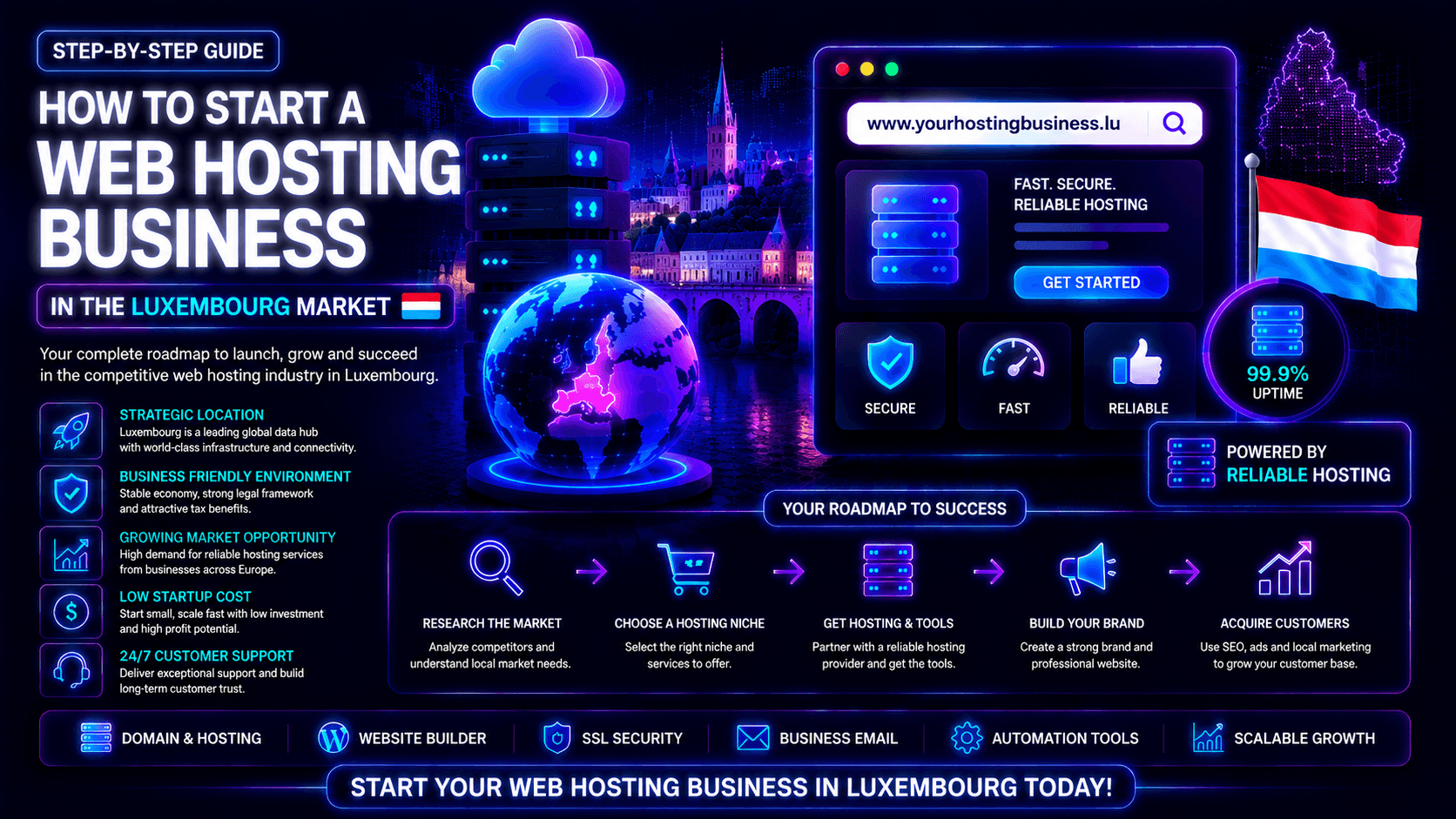
Luxembourg is emerging as a major digital business hub in 2026 thanks to strong digital infrastructure, extensive 5G coverage, and a business-friendly environment. The country ranks highly in Europe for connectivity, innovation, and technology readiness, making it attractive for hosting and cloud businesses. Demand for secure, compliant hosting is rising rapidly, driven by AI, finance, healthcare, and enterprise workloads.
For entrepreneurs, Luxembourg offers valuable advantages including competitive taxation, startup support programs, and access to the wider EU market. Growing investment in data centres and cloud infrastructure creates strong opportunities for premium hosting providers focused on security, reliability, and compliance.
This guide explains how to launch and grow a successful hosting business in Luxembourg.
2. Understanding the Luxembourg Hosting Market
Luxembourg offers excellent digital infrastructure, strong data protection standards, and a business-friendly environment ideal for premium hosting services. Key target customers include financial institutions, healthcare providers, government agencies, startups, and enterprises requiring secure, compliant, and high-performance hosting solutions.
Why Luxembourg Is Attractive for Hosting Businesses
Strong digital infrastructure. Luxembourg ranks among Europe’s leaders for digital connectivity. The country has 95% coverage of very high capacity fixed networks and 99% 5G household coverage. Over 70,000 people work in the ICT sector. Data centre capacity is expected to double within five years, driven by AI workloads and cloud adoption.
High internet penetration. Luxembourg consistently ranks near the top in global internet speed and internet freedom metrics. Your target customers are tech‑savvy, understand the value of premium hosting, and are willing to pay for quality, reliable service.
Business-friendly environment. Luxembourg ranks 2nd in Western Europe for taxation. The government supports digital entrepreneurship through programs like the “From Seed to Scale” strategy, the Luxembourg Digital Innovation Hub (L‑DIH), and incubation centres like Technoport. English is widely accepted in business contexts.
Growing startup and finance sectors. Luxembourg is Europe’s leading hub for investment funds and a growing centre for fintech, blockchain, and AI startups. Financial institutions require hosting that meets strict security, compliance, and data residency requirements. The startup ecosystem is vibrant with coworking spaces and regular networking events.
Types of Customers You Can Target
Small and medium businesses (SMBs). Thousands of SMBs across retail, hospitality, professional services, and construction need websites, email hosting, and basic eCommerce. They value local support and transparent pricing.
Financial companies. Banks, investment funds, and insurance companies need hosting that meets data residency requirements, high security (ISO 27001, SOC 2), high availability (99.99% uptime), and dedicated support. This is a premium, high‑margin segment.
eCommerce stores. Luxembourg consumers shop online, and cross‑border eCommerce (shipping to Germany, France, Belgium) is growing. eCommerce stores need hosting that handles traffic spikes, secures transactions, and loads pages quickly.
Startups and SaaS businesses. Luxembourg’s startup ecosystem is growing, with incubators and government grants. SaaS businesses need cloud or VPS hosting that scales with their user base, with API access, staging environments, and developer‑friendly tools.
Agencies and developers. Web design agencies, digital marketing firms, and freelance developers build websites for clients who need hosting. Offer them white‑label or reseller hosting packages. Agency partners are a scalable acquisition channel.
3. Choose the Right Hosting Business Model
Select a hosting model based on your budget, expertise, and target market. Reseller hosting suits beginners, while VPS, dedicated servers, and cloud hosting offer higher margins and better fit Luxembourg’s demand for secure, enterprise-grade infrastructure.
Reseller Hosting
- Low startup cost. Reseller hosting is the easiest and most affordable way to start a hosting business. You purchase a reseller plan from a larger provider, giving you a pool of resources (storage, bandwidth, email accounts, databases). You then divide those resources into smaller packages and sell them under your own brand. Reseller plans typically cost €20-50 monthly.
- Easy for beginners. You do not need to buy or maintain servers. You do not need to manage data centres or negotiate bandwidth contracts. The upstream provider handles hardware, security patches, and network infrastructure. Your job is customer acquisition, support, and billing.
- Fast launch process. Many reseller plans include WHMCS (billing and automation) and cPanel/WHM (control panel). You can be ready to sell hosting within a day. White‑label options let you brand the control panel with your company logo.
- Best for: Beginners, web designers, digital agencies, and anyone testing the Luxembourg market.
VPS Hosting
- Better performance and flexibility. A Virtual Private Server (VPS) gives you a slice of a physical server with dedicated resources. Unlike reseller hosting, your customers’ performance is not affected by other resellers on the same machine. You have root access for custom software, security configurations, and performance optimization. VPS plans start at €30-100 monthly.
- Suitable for business clients. Luxembourg has many small and medium businesses that need more power than shared hosting but cannot justify a dedicated server. VPS is the perfect middle ground. Clients include law firms, accounting practices, real estate agencies, and professional services.
- Technical requirements: Basic server administration skills or budget to hire a system administrator. Many providers offer managed VPS plans.
- Best for:Growing hosting businesses that have outgrown reseller plans and need more control.
Dedicated Server Hosting
- Premium hosting solution. A dedicated server gives you an entire physical machine. No sharing. Every resource belongs to you alone. This delivers maximum performance for resource‑intensive websites: large eCommerce stores, high‑traffic news sites, and enterprise applications. Dedicated servers cost €100-400+ monthly.
- Enterprise-level customers. Financial institutions, investment funds, and large corporations in Luxembourg require dedicated infrastructure for security, compliance, and performance. They expect 99.99% uptime, fast support, and custom configurations. Higher costs mean higher margins per client.
- Technical requirements: Significant server administration expertise or a dedicated IT team.
- Best for: Established hosting businesses serving enterprise clients.
Cloud Hosting
- Scalable and reliable infrastructure. Cloud hosting spreads your customers’ websites across a network of interconnected servers. Resources scale automatically during traffic spikes. If one server fails, another takes over instantly. You pay for what you use, like a utility bill.
- Ideal for modern businesses. Cloud hosting is perfect for customers with variable traffic: eCommerce stores during sales, SaaS platforms during product launches, or news sites during breaking events. Offer pay‑as‑you‑go pricing, which appeals to Luxembourg startups and seasonal businesses.
- Technical requirements: More knowledge than reseller or VPS, but many providers offer managed cloud platforms.
- Best for: Hosting businesses targeting developers, SaaS companies, and eCommerce stores.
4. Select Reliable Hosting Infrastructure
Choose secure, high-performance infrastructure with SSD/NVMe storage, scalable resources, and EU-based data centres for low latency and GDPR compliance. Prioritise providers offering strong uptime guarantees, cybersecurity protections, and reliable network performance for enterprise customers.
Key Features to Look For
Luxembourg or EU‑based data centres. Server location directly affects website speed, security, and legal compliance. For Luxembourg customers, a server in Luxembourg or neighbouring EU countries (Germany, France, Belgium) delivers the best performance. Choose providers with data centres in Luxembourg itself, or in Frankfurt, Paris, Brussels, or Amsterdam. These locations offer sub‑10ms latency for Luxembourg visitors. Having data centres within the EU also satisfies data sovereignty requirements for financial and government clients.
NVMe SSD storage. Storage type is one of the most overlooked performance factors. NVMe drives deliver speeds 3‑10 times faster than standard SATA SSDs. For WordPress, eCommerce, and database‑driven sites, this difference shows up directly in page load times. In Luxembourg’s premium market, customers expect fast websites. Do not compromise on storage.
Strong uptime guarantee. Uptime is the percentage of time your servers are available. Industry standard is 99.9% (about 8.76 hours of downtime annually). For financial and enterprise clients, premium providers guarantee 99.95% or 99.99%. Your SLA (Service Level Agreement) should match your target market. eCommerce and financial customers need higher uptime than personal blogs. Publish your uptime guarantee prominently.
DDoS protection. Distributed Denial of Service attacks flood your servers with fake traffic, making websites unavailable to real visitors. DDoS protection is non‑negotiable for hosting businesses serving Luxembourg clients. Look for providers offering network‑level DDoS mitigation, configurable firewalls, and automated attack response. Many EU providers include anti‑DDoS protection as standard.
Daily backups and security monitoring. Data loss destroys customer trust. Your infrastructure must include: automated daily backups stored off‑site (different server or cloud location), one‑click restore capability, retention policy (7‑30 days), and proactive security monitoring (malware scanning, intrusion detection). For financial clients, consider offering additional backup retention as a paid add‑on.
Why EU Data Centres Matter
Faster performance for European visitors. Latency is the time data takes to travel from your server to your customer. A Luxembourg data centre serves a Luxembourg user in 2‑5 milliseconds; a server in New York takes 80‑100ms. Every millisecond counts. Hosting within the EU eliminates unnecessary network hops, reduces packet loss, and ensures consistent performance for customers across the Greater Region (Luxembourg, Germany, France, Belgium).
Better data protection compliance. Under GDPR, personal data of EU residents cannot be transferred outside the European Economic Area (EEA) without adequate safeguards. Hosting within the EU simplifies compliance. Luxembourg’s financial sector clients require data residency as part of their regulatory obligations. By using EU‑based data centres, you can confidently offer GDPR‑compliant hosting.
Improved customer trust. Luxembourg customers are increasingly aware of data sovereignty issues. They want to know where their data resides. Advertising “Hosted in EU data centres” or “Data stays in Luxembourg” builds trust and differentiates you from non‑EU competitors. This is especially important when targeting financial institutions, government agencies, and professional services.
Cost vs. performance trade‑offs. Luxembourg itself has limited data centre capacity, with capacity expected to double within five years. For most use cases, Frankfurt (15‑20ms latency to Luxembourg) or Brussels (10‑15ms) offer excellent performance at potentially lower costs. The added 5‑10ms of latency is imperceptible for most websites, including eCommerce stores and business sites.
5. Legal & Business Setup in Luxembourg
Register your company through Luxembourg’s business authorities, secure the required tax registrations, and comply with GDPR and EU data protection laws. Clear policies, proper invoicing, and strong cybersecurity practices are essential for operating a trusted hosting business.
Business Registration Basics
Choose your company name. Your business name must be unique and include “SARL” (Société à Responsabilité Limitée) if you choose a private limited liability structure . Check name availability through the Luxembourg Business Register (LBR) portal before proceeding.
Register your business legally. The most common structure for hosting businesses is the SARL (private limited liability company). Requirements include: minimum share capital of EUR 12,000 (proposed legislation may allow deferred payment up to 12 months after incorporation) , at least one manager of any nationality, a registered office address in Luxembourg (domiciliation services available), and beneficial ownership disclosure .
Registration steps:
- Prepare Articles of Association with legal counsel (EUR 2,000-5,000)
- Notary execution (EUR 1,500-3,000)
- File with Luxembourg Business Register (EUR 75)
- Complete tax registration (no additional fee)
- Open business bank account (EUR 12,000 minimum capital deposit)
Luxembourg’s online portal (renovated August 2025) now centralises procedures through four main “tiles”: register, file, consult, and order . Standard registration takes 2-3 weeks, with expedited options available .
Open a business bank account. BGL BNP Paribas and other banks offer professional accounts with promotional fee waivers for new businesses . The incorporation process requires a Luxembourg bank account prior to completion.
Register your domain name. Domain registration can be completed through any accredited registrar. Luxembourg’s .lu domain registry (Restena) confirms there are no nationality or residency requirements for registering .lu domains—anyone can register one through accredited registrars .
Important Compliance Requirements
GDPR compliance. As a hosting provider, you will process customer personal data (names, email addresses, IP addresses, payment information). GDPR applies fully. Key obligations include:
- Maintaining a record of processing activities
- Having a lawful basis for data processing (typically contract performance)
- Appointing a data protection officer if processing is core to your business
- Notifying the CNPD within 72 hours of a data breach
Privacy policy and terms. Your website must include:
- Data controller identity and contact information
- Categories of personal data collected
- Legal bases for processing
- Data retention periods
- Information about data transfers
- Customer rights (access, rectification, erasure, portability, objection)
Luxembourg hosting providers must also comply with bank secrecy laws if handling financial data, with disclosure regulated by the CSSF .
Secure customer data handling. Luxembourg-regulated data centres are available for hosting sensitive customer data. The country enforces strict AML/CFT requirements, including beneficial ownership disclosure at registration . Data security measures should include encryption in transit (TLS 1.2+), encryption at rest (AES-256), access controls and MFA, regular security patching, and incident response procedures .
Other compliance considerations: Register for VAT if annual turnover exceeds EUR 35,000 (standard rate 17%), maintain annual accounts with the Business Register, file corporate tax returns by May 31st, and comply with ongoing AML reporting requirements .
6. Build Your Hosting Brand
Create a professional brand with a strong logo, premium website, and clear messaging focused on security, reliability, and compliance. Trust signals like certifications, transparent policies, testimonials, and responsive support help attract enterprise and financial clients in Luxembourg’s premium hosting market.
Create a Professional Identity
Logo and branding. Your logo appears on your website, invoices, social media, and email signatures. Invest in a clean, modern logo that works in colour and black‑and‑white. Choose a brand colour palette (primary, secondary, accent) and stick to it. Use professional fonts (avoid default system fonts). If the budget is tight, use Canva or Looka; for a premium look, hire a Luxembourg‑based freelance designer (€200‑500). Ensure your brand reflects your target market: conservative for financial clients, modern for startups.
Professional business email. Use your domain for email: yourname@yourbusiness.lu, support@yourbusiness.lu, billing@yourbusiness.lu. Never use Gmail or Yahoo for business communication. Google Workspace or Microsoft 365 are standard. Set up email signatures with your name, title, company name, phone number, and logo.
Modern hosting website. Your website is your sales floor. It must be: fast (NVMe hosting, CDN), mobile‑responsive, secure (SSL certificate, security badges), and easy to navigate. Essential pages: homepage (clear value proposition), pricing (transparent, side‑by‑side comparison), about us (your story, team photos), contact (form, email, phone, address), support centre (knowledge base, ticket system), and knowledge base (tutorials, FAQs). Consider offering content in English and French (or German) to reach Luxembourg’s multilingual market.
Clear pricing structure. Luxembourg customers value transparency. Display monthly and annual prices. Show promotional and renewal rates clearly. Include VAT (currently 17%). Use a simple tier structure: Basic (1‑5 websites), Business (10‑25 websites), Enterprise (unlimited). Highlight the most popular plan. Avoid hidden fees; publish setup costs, cancellation fees, and overage charges.
Build Customer Trust
Transparent policies. Publish your terms of service (acceptable use, payment terms, cancellation policy) and privacy policy (GDPR compliance, data handling, cookie policy) prominently. Include a Service Level Agreement (SLA) with uptime guarantees (99.9% minimum) and service credits for downtime. Make policies easy to find, not buried in footer links.
Customer testimonials. Display real customer reviews with names, company names, and photos (with permission). Generic “5 stars” testimonials are less convincing than specific ones: “Our eCommerce sales increased 30% after switching to [Your Brand].” If you are new, offer discounted hosting to early customers in exchange for honest testimonials.
Secure payment gateways. Offer multiple payment methods: credit cards (Stripe, Braintree), PayPal, and bank transfers (popular in Luxembourg). Luxembourg customers appreciate Bancontact and iDEAL if you serve cross‑border customers. Display security badges (SSL, PCI compliance) prominently at checkout.
Other trust builders: SSL certificate (free Let’s Encrypt included in all plans). Uptime badge showing real‑time status (or a status page). Money‑back guarantee (30 days is standard). Professional support (live chat, ticket, phone). Active social media presence (LinkedIn, Twitter) showing you are a real business.
7. Create Hosting Packages
Design clear tiered hosting plans with transparent pricing, scalable resources, and premium security features. Offer profitable add-ons like backups, SSL certificates, managed support, and compliance-focused services tailored to Luxembourg’s enterprise and financial customers.
Shared Hosting Plans
- Personal website hosting (Entry‑level). Target: personal blogs, freelancers, small portfolios. What to include: 1 website, 5‑10 GB NVMe storage, 25‑50 GB bandwidth, 1 database, 5 professional email accounts, free SSL certificate, and weekly backups (automated). Price: €5-8 monthly (promotional) / €10-15 monthly (renewal).
- Business hosting (Mid‑range). Target: growing small businesses, eCommerce stores, professional services. What to include: 5‑10 websites, 25‑50 GB NVMe storage, 100‑200 GB bandwidth, unlimited databases, unlimited email accounts, free SSL, daily backups, free CDN, and staging environment. Price: €10-15 monthly (promotional) / €18-25 monthly (renewal).
- Premium hosting (High‑tier). Target: agencies, high‑traffic eCommerce, financial companies (basic websites). What to include: unlimited websites, 100‑250 GB NVMe storage, unmetered bandwidth, unlimited databases, unlimited email, free SSL, daily backups with longer retention, free CDN, staging environment, malware scanning and removal, and priority support. Price: €18-25 monthly (promotional) / €30-40 monthly (renewal).
- Important considerations: Display prices with VAT (17% in 2026) clearly. Offer both monthly and annual billing; discount annual plans by 15‑20%. Avoid “unlimited” storage claims—Luxembourg customers value honesty. Use “unmetered” bandwidth instead, with fair use policies. NVMe storage is non‑negotiable; cheap SATA storage is 3‑10x slower.
Extra Services You Can Offer
- Domain registration. Many customers do not have a domain yet. Offer registration for €12-18 per year for .lu, .com, .net, .org, etc. Promote .lu domains as a local trust signal.
- SSL certificates. Free Let’s Encrypt SSL is included in all plans. For customers who need higher validation (EV or OV certificates for eCommerce or financial sites), offer premium SSL from €40-100 annually.
- Website migration. Some customers come from other hosts and need help moving their sites. Offer migration service for €50-150 per site (depending on complexity). Standard migrations (WordPress, cPanel to cPanel) are simpler; custom applications cost more.
- Email hosting. While standard email accounts are included in hosting, some customers want more robust email hosting (Exchange, larger mailboxes, advanced spam filtering). Partner with Google Workspace or Microsoft 365 and offer resold plans at a small markup. Price: €5-8 per user monthly.
- Managed WordPress hosting. WordPress is the most popular CMS. Offer a specialised package with: server‑level caching (LiteSpeed or Nginx + Redis), automatic WordPress core and plugin updates, staging environment, daily backups, and expert WordPress support. Price: €20-40 monthly. Market to agencies and freelancers.
- Other add‑ons to consider: Dedicated IP address, premium CDN tier (from free to paid), daily backups with extended retention (30‑90 days), malware removal service, website maintenance packages (monthly updates, security scans), and SEO tools.
8. Essential Hosting Tools & Software
Use billing and automation platforms, hosting control panels like cPanel or Plesk, and monitoring and security tools such as firewalls, backups, malware scanning, and uptime monitoring to streamline operations and protect your hosting infrastructure.
Billing & Automation Tools
WHMCS is the industry standard for hosting billing and automation, deeply integrated with cPanel and Plesk. It handles recurring invoicing, payment collection (Stripe, PayPal, credit cards, bank transfers), domain registration (integrates with Enom, Namecheap, OpenSRS), automated account provisioning (creates control panel accounts instantly when customers pay), suspension and termination (automatic on non‑payment), and support ticketing. Pricing starts at $18.95 monthly for up to 250 clients.
For specific EU requirements, WHMCS offers built‑in tax support for VAT (including Luxembourg’s 17% rate), invoice numbering that complies with local regulations, and multi‑currency support (EUR, USD, GBP). Automated invoicing is critical at scale. WHMCS sends invoices automatically on your billing cycle (monthly, quarterly, annually), retries failed payments (dunning management), sends overdue reminders, and applies late fees.
Customer management tools beyond WHMCS include HostBill (feature‑rich, steeper learning curve) and Blesta (open‑source, developer‑friendly). For most hosting businesses, WHMCS is the safe, well‑documented choice with the largest ecosystem of modules, payment gateways, and domain registrars.
Hosting Control Panels
cPanel & WHM is the most widely used control panel. cPanel is for your customers (manages files, emails, databases, domains). WHM (Web Host Manager) is for you (creates and manages customer accounts, sets resource limits, configures server settings). However, recent security vulnerabilities (CVE‑2026‑41940, an authentication bypass affecting all cPanel and WHM versions after 11.40) have raised concerns. Ensure you apply patches promptly.
Plesk is the primary alternative to cPanel. It works on both Linux and Windows servers, has a more modern interface, and offers better built‑ in security features (modsecurity, fail2ban, firewall). Plesk’s WordPress Toolkit (staging, cloning, bulk updates) is superior to cPanel’s offering. European providers often prefer Plesk for its GDPR‑friendly data handling.
DirectAdmin is a lightweight, affordable control panel for budget‑focused hosting businesses. It consumes fewer server resources than cPanel or Plesk, costs less per account, and covers essentials (file management, email, databases, DNS). DirectAdmin is less common, so customer familiarity may be lower, but its simplicity appeals to European users.
For a Luxembourg hosting business targeting financial clients, Plesk offers the best balance of security, modern interface, and European compliance. For budget‑focused beginners, DirectAdmin provides excellent value.
Security & Monitoring Tools
Firewall protection. Every hosting server needs a firewall. ConfigServer Security & Firewall (CSF) is the standard on Linux servers. It blocks brute force attacks, limits connection rates, and integrates with control panels. Most control panels include built‑in firewall configuration tools.
Malware scanning. Your customers expect you to keep their websites safe. Imunify360 is the industry standard for shared and VPS hosting environments. It combines a web application firewall (WAF), malware scanning, DDoS protection, and proactive threat detection. Pricing starts around €12-25 monthly per server. For EU‑based providers, ensure your malware scanning tool complies with GDPR (logs anonymised, data not leaving EU).
Automated backup systems. Backups are your last line of defence. JetBackup is the standard tool for cPanel servers. It creates automated backups, stores them off‑site (Amazon S3 EU, Google Cloud EU), and alerts you if a backup fails. Store backups within the EU for GDPR compliance. For customers who want extra protection, offer backup upgrades (daily backups with 30‑day retention vs. weekly with 7‑day retention).
Other security essentials: Two‑factor authentication for your own hosting account and customer portals. SSL automation – Let’s Encrypt provides free certificates; ensure your control panel automatically issues and renews them. DDoS protection at the network level, typically provided by your infrastructure provider. Regular security audits of your own server configurations.
9. Build a High-Converting Hosting Website
Create a professional website with clear pricing, hosting plans, security details, FAQs, and support options. Add trust signals like uptime guarantees, certifications, testimonials, and secure checkout to increase conversions and attract enterprise clients.
Important Pages
- Homepage. The homepage must answer three questions within five seconds: what do you sell (hosting), who is it for (Luxembourg small businesses, financial firms, agencies), and why choose you (fast, secure, local support). Include a clear call‑to‑action (CTA) button: “View Plans” or “Get Started.” Use professional imagery, not generic stock photos. Consider featuring Luxembourg landmarks or flags to establish local credibility.
- Pricing page. Your pricing page should compare plans side by side. Use a table format with columns for Personal, Business, and Premium plans. Highlight the most popular plan (Business) with a “Best Value” badge. Include monthly and annual pricing. Annual billing discounts (e.g., 2 months free) improve cash flow. Be transparent about renewal rates—hidden price increases generate negative reviews. Display prices with VAT (17%) clearly. Offer pricing in EUR.
- About us. Customers buy from people, not logos. Introduce your team (real names, photos, roles). Share your story: why you started the hosting business, what you value, and how you are different. If you are a solo founder, that is fine. Authenticity beats corporate polish. If you speak multiple languages (Luxembourgish, French, German, English), mention this—it is a competitive advantage.
- Contact page. The contact page should include a simple form (name, email, message), your physical address (even if it is a virtual office in Luxembourg), phone number (Luxembourg number preferred), email address, and a map. Also list your social media profiles and business hours. For enterprise clients, offer a dedicated phone line.
- Support centre. Your support page should list all contact options: live chat (24/7 if available), ticket system, phone number (if applicable), and email. Also include your support hours, average response times, and a link to your knowledge base. Luxembourg customers expect fast, local support during business hours (CET).
- Knowledge base. A knowledge base reduces support tickets. Write articles in English (and French/German if possible): “How to point your domain to our nameservers,” “How to create an email account in Plesk,” “How to install WordPress,” “How to access phpMyAdmin,” and “How to restore a backup.” Organise articles by category (Getting Started, Email, Domains, Security, Troubleshooting).
Features That Improve Conversions
- Live chat support. Live chat converts visitors who have quick questions before buying. You do not need 24/7 coverage initially. Start with Luxembourg business hours (9‑5 CET); add 24/7 as you grow. Tools like Tawk.to are free; Zendesk Chat and LiveChat are premium options. Ensure your chat agents speak English (and French or German if possible).
- Speed and uptime guarantees. Hosting customers care about reliability. Display your uptime guarantee prominently (99.9% minimum). Explain what happens if you miss it (service credits). Publish a real‑time status page or badge showing your uptime. Luxembourg financial clients especially value uptime guarantees.
- Free migration service. One of the biggest barriers to switching hosts is the hassle of moving websites. Offer free migration for new customers. Most migrations can be automated or handled by your support team. This removes friction and accelerates signups. Highlight this offer prominently on your pricing page.
- Client reviews and testimonials. Display real customer reviews prominently. Include the customer’s name, company, and photo (with permission). Generic “Great host, 5 stars” testimonials are less convincing than specific ones: “Our financial services website loads 40% faster after switching to [Your Brand].” If you are new, offer discounted hosting to early customers in exchange for honest testimonials.
- Other conversion elements: Money‑back guarantee (30 days is standard). Security badges (SSL, DDoS protection, daily backups). Trust seals (GDPR compliant, EU data centres). Clear call‑to‑action buttons on every page.
10. Pricing Strategy for the Luxembourg Market
Set premium pricing focused on value, security, and reliability rather than low cost. Offer tiered plans for different business sizes and increase revenue through upsells like backups, compliance tools, and managed hosting services tailored to Luxembourg’s enterprise clients.
How to Price Your Hosting Services
Research local and EU competitors. Study pricing from Luxembourg-based hosting providers (if any) and EU competitors targeting the Luxembourg market (German, French, Belgian hosts). Note their promotional prices and renewal rates. Also examine managed WordPress hosts and cloud providers. Your pricing should be in the premium range, reflecting higher service levels, local support, and EU data centre compliance.
Monthly and yearly pricing models. Monthly plans attract price-conscious customers and those testing your service. Yearly plans improve your cash flow and reduce churn. Discount yearly plans by 15‑25% compared to monthly billing. For example, €15 monthly or €144 annually (€12 per month effective). Luxembourg customers appreciate annual billing for predictability.
Offer starter discounts. Promotional pricing creates urgency. Offer 30‑50% off the first 3‑6 months. After the promotional period, prices revert to standard renewal rates. Be transparent: display both promotional and renewal prices on your pricing page. Luxembourg consumer law requires clear disclosure of final prices including VAT.
Other pricing tips: Include a 30‑day money‑back guarantee on all plans. Avoid hidden fees—Luxembourg customers value transparency. Price in EUR with VAT (17%) clearly displayed. Consider offering a free trial (7‑14 days) for risk‑free testing.
Ways to Increase Revenue
Upsell VPS hosting. When a shared hosting customer outgrows their plan, offer a seamless upgrade path to VPS. Train your support team to recognise resource usage patterns (high CPU, memory, or database connections). VPS plans start at €30-80 monthly. Highlight dedicated resources, root access, and better performance for growing businesses.
Managed hosting services. Many customers do not want to manage their own hosting. Offer managed services for a premium: server security monitoring and patching, WordPress plugin updates, malware cleanup, performance optimisation, and proactive support (you call them when you detect an issue). Price managed services at €20-50 monthly above standard hosting. Financial clients especially value managed services.
Web design and SEO packages. Small business customers often need both hosting and a website. Offer simple website design packages: 5‑page brochure site, WordPress setup, contact form, and basic SEO. Price at €500-1,500 one‑time. You can outsource design to freelancers while you manage the customer relationship. Add SEO packages (keyword research, local SEO, monthly reporting) at €50-200 monthly.
Other upsell opportunities: Domain registration (low margin but keeps customers in your ecosystem). Premium SSL certificates (Let’s Encrypt is free; offer EV certificates for €40-80 annually). Daily backups with extended retention (7‑day retention included; offer 30‑day or 90‑day retention for €3-8 monthly). Dedicated IP addresses for eCommerce or email sending (€2-5 monthly).
11. Marketing Strategies to Get Luxembourg Clients
Use SEO, paid ads, and content marketing to reach targeted audiences. Focus on LinkedIn and B2B channels for enterprise clients, and build referral or affiliate programs to attract agencies, SMEs, and long-term hosting customers.
SEO Marketing
- Target Luxembourg hosting keywords. Generic keywords like “web hosting” are dominated by international giants. Instead, target long‑tail, intent‑rich phrases: “managed WordPress hosting for Luxembourg financial firms,” “GDPR‑compliant cloud hosting Luxembourg,” “VPS hosting for Luxembourg startups,” “reseller hosting for web designers.” Also target local keywords: “web hosting for small business in Luxembourg City,” “eCommerce hosting for Luxembourg online stores,” “hosting near Kirchberg.”
- Create blog content regularly. Write blog posts that answer Luxembourg customer questions: “How to choose a web host: 7 factors for Luxembourg small businesses,” “Shared vs VPS vs Cloud: which is right for your Luxembourg website?” “How to migrate your website to a new host (step by step),” “GDPR compliance for hosting: what you need to know.” Each blog post is an opportunity to rank for relevant keywords and demonstrate your expertise.
- Optimise for multilingual audiences. Luxembourg has three official languages: Luxembourgish, French, and German. English is widely used in business. Offer your website and key content in at least English and French (or German). Use hreflang tags to signal language versions to Google. Translate key landing pages and blog posts. This is a competitive advantage over international hosts that offer only English.
Paid Advertising
- Google Ads campaigns. Google Ads captures customers actively searching for hosting. Bid on keywords with commercial intent: “buy web hosting Luxembourg,” “VPS hosting Luxembourg,” “managed WordPress hosting Luxembourg.” Start with a €20-40 daily budget. Use location targeting (Luxembourg only). Use negative keywords to exclude free or low‑intent searches. Track conversions (signups, purchases) not clicks.
- Facebook and LinkedIn Ads. Facebook Ads reach consumers and small business owners. LinkedIn Ads target professionals, decision‑makers, and financial services employees. Use LinkedIn for B2B hosting sales. Target by job title (IT manager, business owner, CEO), company size, and industry (financial services, professional services). Run brand awareness campaigns on Facebook; run lead generation campaigns on LinkedIn.
- Retargeting campaigns. Most website visitors will not buy on their first visit. Install retargeting pixels on your website. Show follow‑up ads to people who visited your pricing page but did not sign up. Offer a discount or free migration in retargeting ads.
Content Marketing
- Hosting tutorials. Create video and written tutorials: “How to start a Luxembourg website in 30 minutes,” “Plesk tutorial for beginners,” “WordPress vs Shopify vs custom build.” These attract organic traffic and position you as an expert. Share on YouTube and embed on your blog.
- Security and performance guides. Luxembourg financial clients care deeply about security. Write guides: “GDPR compliance for website owners,” “How to secure your WordPress site,” “Understanding DDoS protection,” “Choosing the right backup strategy.” Use these guides as lead magnets (downloadable in exchange for email address).
- Business-focused blog articles. Write about topics relevant to Luxembourg business owners: “Top 5 website mistakes Luxembourg small businesses make,” “How to improve your website conversion rate,” “The cost of website downtime for financial firms.” These articles attract decision‑makers.
Referral & Affiliate Programs
- Offer commissions for referrals. Affiliates are your sales force. Offer competitive commissions: one‑time €40-80 per sale or recurring 15‑30% of monthly payments for the customer’s lifetime. Provide affiliates with banners, text links, email templates, and promotional content. Use WHMCS built ‑ in affiliate management or a dedicated platform.
- Partner with agencies and developers. Web designers, digital marketing agencies, and IT consultants are natural hosting resellers. They build websites for clients who need hosting. Offer them white‑label hosting (they brand it as their own), priority support, and generous commissions. Attend Luxembourg business events (Chamber of Commerce, Digital Luxembourg, ICT Spring) to network in person.
12. Customer Support Strategy
Offer fast, expert, multilingual support via live chat, email, and ticket systems. In Luxembourg’s premium market, responsive and knowledgeable support builds trust, improves retention, and encourages referrals from enterprise and financial clients.
Why Excellent Support Matters
Builds long-term trust. When a customer’s website goes down or an email stops working, they panic. Every minute feels like an hour. A support ticket that takes 4 hours to receive a response is unacceptable. A live chat response in 60 seconds builds loyalty for life. Aim for first response under 2 hours for tickets, under 5 minutes for live chat (during business hours). Luxembourg clients, particularly in the financial sector, expect fast, professional support.
Improves customer retention. Customers leave hosts not because of price, but because of problems. A slow website that never gets fixed. A migration that fails and no one helps. A security breach that could have been prevented. When you resolve technical issues quickly and competently, customers stay for years. The lifetime value of a retained customer far exceeds the cost of supporting them. In Luxembourg’s small market, word of mouth travels fast; poor support will damage your reputation permanently.
Creates positive reviews. Satisfied customers leave reviews. Positive reviews on Google, Trustpilot, and Luxembourg business directories attract new customers. Negative reviews deter them. Every support interaction is an opportunity to earn a testimonial. After resolving an issue, ask: “Would you be willing to leave a review about your experience?” Make it easy with direct links.
Best Support Channels
Live chat. Live chat is the most important support channel in hosting. Customers want immediate answers, not email waiting. Live chat response times should be under 2 minutes during Luxembourg business hours (9‑5 CET). Tools: Tawk.to (free, simple), Zendesk Chat (premium, integrates with ticketing), or WHMCS built‑in chat (basic). If you cannot staff live chat 24/7 initially, offer it during business hours and clearly display those hours.
Ticket support. Ticketing systems provide structure and accountability. Each support request gets a number. Customers can track progress. Agents can see history. WHMCS includes a built‑in ticket system with departments (Sales, Billing, Technical Support, Abuse). Tickets are best for complex issues that require research or escalation. Set clear response time expectations: 2‑4 hours for standard tickets, 24 hours for low‑priority.
Email support. Email is the baseline support channel. Every hosting business must offer email support. Customers expect to email support@yourbusiness.lu. The challenge is managing volume. Use a helpdesk system that converts emails into tickets (WHMCS, Freshdesk, Zendesk). Never let emails sit in a shared inbox. Respond within 4 business hours.
WhatsApp or phone support. WhatsApp is increasingly popular for European business communication, especially for customers who prefer messaging over email. You can send images, videos, documents, and voice notes. Phone support is expensive to staff but valuable for emergencies. If you offer phone support, clearly state your hours (e.g., “9am‑5pm CET, Monday‑Friday”) and expected wait times. For premium clients, offer 24/7 emergency phone support as a paid add‑on.
Language considerations. Luxembourg has three official languages (Luxembourgish, French, German). English is widely used in business. Ensure your support team can communicate in at least English and French (or German). This is a competitive advantage over international hosts.
13. Common Mistakes to Avoid
Avoid unreliable infrastructure, GDPR non-compliance, weak support, poor website performance, and inadequate cybersecurity. These mistakes damage trust, reduce performance, and can quickly lead to lost enterprise and financial clients in Luxembourg’s premium hosting market.
Choosing Unreliable Infrastructure
The cheapest server is rarely the best value. Low‑cost providers overcrowd servers, use outdated hardware (HDDs instead of NVMe SSDs), and offer minimal support. Your customers will experience slow page loads, frequent downtime, and frustrated visitors. The result? High churn and negative reviews. In Luxembourg’s premium market, where financial and enterprise clients demand performance, unreliable infrastructure is fatal. Invest in quality infrastructure with NVMe storage, EU‑based data centres (preferably Luxembourg, Germany, or France), and strong uptime guarantees (99.9% minimum). Your reputation depends on it.
Ignoring GDPR Compliance
Luxembourg is at the heart of EU data protection regulation. Ignoring GDPR can lead to fines up to €20 million or 4% of global annual turnover. Common compliance mistakes include: no privacy policy or terms of service on your website, not registering with the CNPD (Luxembourg’s data protection authority) if required, failing to document your data processing activities, no data processing agreement with your upstream infrastructure provider, no breach notification procedure (72 hours), and no process for customers to request data deletion. Consult a Luxembourg lawyer specialising in GDPR before launching.
Weak Customer Support
Hosting problems happen 24/7. A server issue at 3 AM on a Sunday needs attention. Customers who cannot reach you will leave—and tell others. Poor support includes: slow response times (24+ hours), unhelpful scripted answers, no live chat option, support only during Luxembourg business hours (customers expect evenings and weekends), and no knowledge base for self‑help. In Luxembourg’s small market, negative word of mouth spreads quickly. Invest in support. Even if you are a solo founder, be available. Set clear response time expectations (2‑4 hours for tickets, 5 minutes for live chat) and meet them consistently.
Poor Website Optimisation
Your website is your sales floor. A slow, poorly designed, or hard‑to‑navigate site drives potential customers away. Common mistakes include: slow loading speed (no CDN, no caching, cheap hosting for your own site), non‑mobile‑responsive design, unclear pricing (hidden fees, missing VAT), no about us page (customers buy from people), and missing knowledge base (support tickets increase). Invest in a fast, professional website. Test on mobile devices. Be transparent about pricing. Include clear calls‑to‑action.
Underestimating Cybersecurity
Your customers trust you with their websites, data, and often their customers’ information. A security breach destroys that trust instantly. Common cybersecurity mistakes include: no firewall on your servers, no malware scanning for customer sites, no automated backups (or backups stored on the same server), no DDoS protection, no two‑factor authentication for your own hosting account, and failing to apply security patches promptly. Build security into your infrastructure from day one. Use CSF firewall, Imunify360 malware scanning, JetBackup with off‑site storage, and enforce 2FA. Your customers’ security is your responsibility.
14. Estimated Startup Cost
Startup costs depend on your model. Reseller hosting is affordable for beginners, while VPS or dedicated setups require higher investment. In Luxembourg, additional costs may include compliance, security tools, and premium infrastructure for enterprise-grade hosting services.
Beginner Setup (Reseller Hosting)
| Item | Estimated Cost | Notes |
| Reseller hosting plan (EU data centre) | €20-50 monthly | Includes server resources, control panel, basic support |
| Domain registration (.lu or .com) | €12-18 yearly | .lu domain signals local presence |
| Business email (Google Workspace) | €6 monthly per user | Professional email with your domain |
| Billing software (WHMCS) | €18-25 monthly | Up to 250 clients; annual license discounts available |
| Logo and branding | €100-300 one-time | Freelance designer or DIY tools |
| Business registration (SARL) | €2,000-5,000 one-time | Notary, registration, legal fees |
| GDPR compliance (legal advice) | €500-1,500 one-time | Privacy policy, terms, data processing |
| Marketing (initial) | €100-300 monthly | Google Ads, content creation |
| Monthly recurring total | €55-100 | Excluding one-time costs |
| First year total estimate | €3,500-8,000 | Includes one-time and recurring costs |
Beginner setup is ideal for testing the market. The high one-time legal costs reflect Luxembourg’s SARL requirements. Consider starting as a sole proprietorship initially, then converting to SARL when you have revenue.
Advanced Setup (VPS or Dedicated Servers)
| Item | Estimated Cost | Notes |
| VPS hosting (managed, EU data centre) | €50-150 monthly | More control, better performance, scalability |
| Dedicated server (optional) | €100-400+ monthly | For high-performance needs or enterprise clients |
| Team hiring | €2,000-10,000+ monthly | Support staff, system administrators |
| Premium support systems | €50-150 monthly | Advanced helpdesk, phone support, monitoring |
| Security tools (Imunify360) | €15-30 monthly per server | Malware scanning, WAF, DDoS protection |
| Professional website design | €1,000-4,000 one-time | Custom design, not template |
| Marketing (ongoing) | €300-1,000+ monthly | SEO, paid ads, content, affiliate program |
| Monthly recurring total | €2,500-7,500+ | Excluding one-time costs |
| First year total estimate | €30,000-90,000+ | For a full-scale hosting business |
Advanced setup is for established hosting businesses or those targeting enterprise and financial clients. Startup costs are substantial; return on investment may take 12-24 months.
15. How to Scale Your Hosting Business
Scale by expanding into cloud and managed hosting, offering white-label reseller solutions, and targeting enterprise clients. Build partnerships with agencies and financial firms in Luxembourg to increase recurring revenue and reduce customer acquisition costs.
Launch Cloud Hosting Solutions
Cloud hosting appeals to developers, SaaS companies, and eCommerce stores with variable traffic. Resources scale automatically during traffic spikes; customers pay only for what they use. In Luxembourg, cloud hosting is particularly attractive to fintech startups and seasonal businesses. Offer self-service VPS creation through your control panel with hourly billing. Provide API access and detailed usage analytics. Start with a provider like DigitalOcean, Vultr, or AWS (EU regions) and brand the experience as your own.
Expand into Managed Hosting
Many customers do not want to manage their own servers. Managed hosting is a premium service where you handle security updates, performance optimization, backups, and proactive monitoring. This is especially valuable for financial and enterprise clients who lack in-house server expertise. Price managed hosting at 30-50% above standard plans. Offer tiered managed services: basic (security updates, weekly backups), professional (adds performance optimization, monthly reporting), and enterprise (adds dedicated account manager, 24/7 phone support).
Offer White-Label Reseller Hosting
White-label hosting allows other businesses to resell your hosting under their own brand. This is a scalable growth channel. Your partners do the marketing and customer acquisition; you provide the infrastructure and support. Target web design agencies, IT consultants, and marketing agencies in Luxembourg and the Greater Region (Germany, France, Belgium). Provide partners with custom nameservers, branded control panel, WHMCS integration, and dedicated partner support. Offer generous commissions (20-30% recurring) to attract quality partners.
Target Enterprise Businesses
Luxembourg’s financial sector offers high-value enterprise opportunities. Banks, investment funds, insurance companies, and professional services firms need hosting that meets strict security, compliance, and performance requirements. To target enterprise clients, obtain ISO 27001 certification (information security management), offer dedicated account management, provide 24/7 phone support with guaranteed response times (15 minutes for critical issues), sign Business Associate Agreements (BAAs) for data processing, and offer custom infrastructure (dedicated servers, private cloud, hybrid solutions). Enterprise contracts are larger and longer-term, but sales cycles are longer (6-12 months).
16. Final Thoughts
Luxembourg is a strong, high-value market for premium hosting in 2026, driven by world-class infrastructure, financial institutions, and cross-border demand. Customers prioritise security, reliability, and compliance over low pricing, creating opportunities for quality-focused providers.
Success depends on strong foundations: GDPR compliance, EU-based infrastructure, robust security, and transparent uptime guarantees. In this market, trust is everything.
Start small with reseller hosting, focus on excellent service for your first clients, and scale gradually into VPS, cloud, and enterprise solutions. Reinvest in infrastructure, support, and marketing as you grow.
With patience and consistency, Luxembourg offers sustainable, long-term recurring revenue for well-positioned hosting businesses.

Leave a Comment