
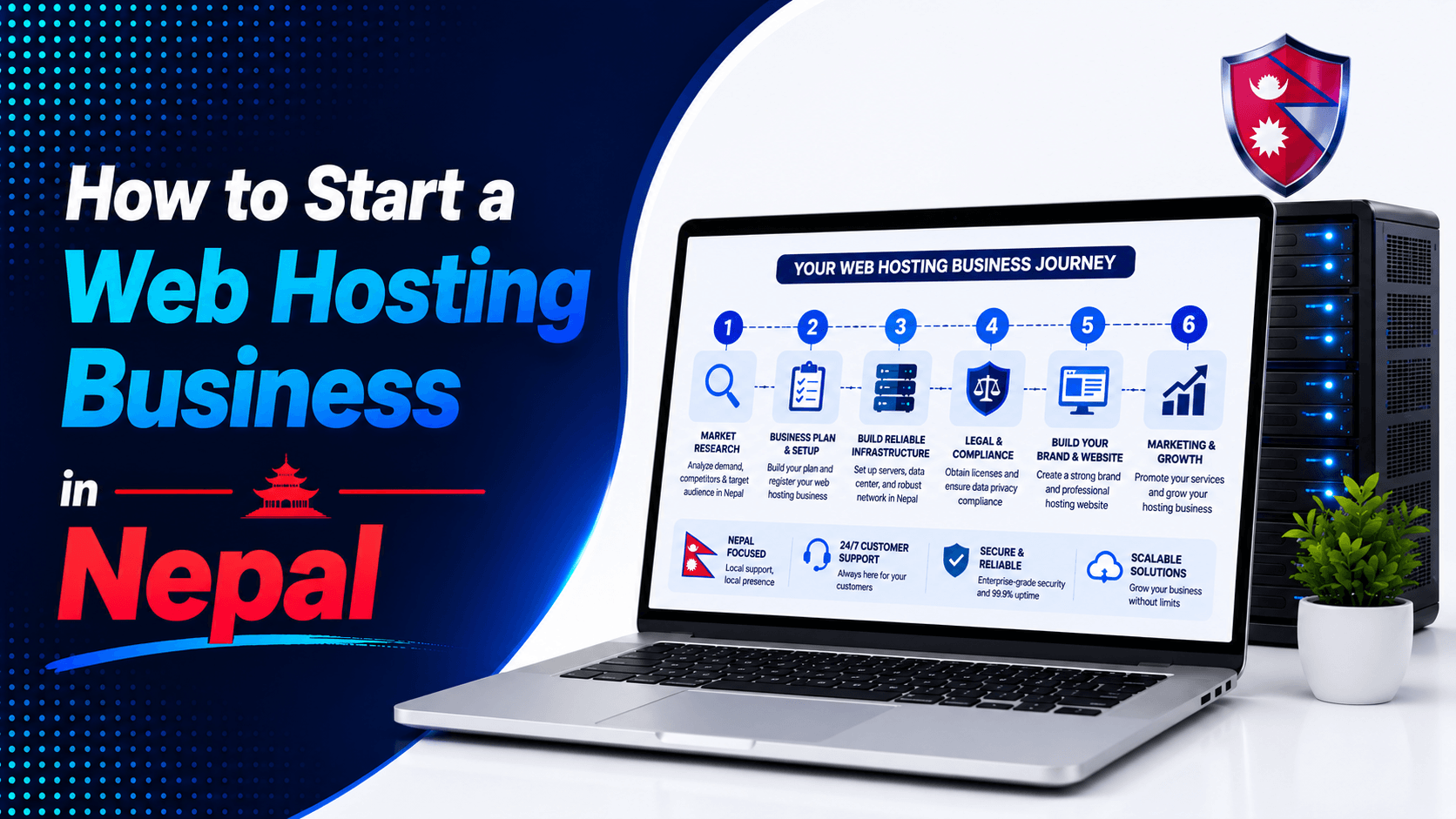
Nepal’s digital economy is growing fast. This growth boosts the need for reliable and affordable web hosting. Local providers have a big chance to succeed. They can offer fast performance and prices in NPR. They can also provide support in Nepali.
You can start small with a reseller plan. It has low costs. Later, you can grow into VPS and cloud hosting. You can also add other digital services. This guide will help you build Web Hosting Business in Nepal. It covers legal setup, infrastructure, pricing, marketing, and support. It also highlights common mistakes to avoid.
Understand the Web Hosting Industry
Before you start, learn how web hosting works. It stores website files on servers. Then it makes those files available online through a domain name. You should also know the different services you can offer.
Types of Hosting Services
Different websites need different hosting types. Their budgets also vary. Here are the main options:
- Shared Hosting: This is affordable and beginner-friendly. Multiple websites share the same server resources. It usually costs $3–15 per month.
- VPS Hosting: This gives you isolated resources. You get more control over your environment. It works well for growing websites. Prices range from $20–100 per month.
- Cloud Hosting: This uses many servers together. It allows for flexible scaling. Performance is very reliable. Typical prices are $10–150+ per month.
- Dedicated Servers: You get an entire physical server. It is for just one customer. This offers maximum performance and control. It costs around $100–500+ per month.
- WordPress Hosting: This is specially optimized for WordPress. It includes caching and automatic updates. You also get specialized support. Plans cost around $10–100 per month.
- Reseller Hosting: This lets you buy hosting and resell it. You can use your own brand name. It is great for beginners and agencies. Starting price is around $20–50 per month.
Why Nepal is a Growing Market: More Nepali businesses now go online. This drives up demand for reliable hosting. Local providers can compete well. They can offer fast servers in Singapore or India. They can price services in NPR. They can give support in Nepali and English. They can also accept local payments like eSewa and Khalti.
Choose Your Web Hosting Business Model
Your business model decides your costs, skills, and customers. In Nepal, you have three main paths. You can start as a reseller.
Reseller Hosting Business
Reseller hosting is the simplest way to begin. You buy resources from a big provider. Then you sell them under your brand. It is affordable and beginner-friendly.
- Best for beginners: You do not manage servers or data centres. The provider handles hardware and security. You focus on customers, support, and billing. This keeps things simple.
- Low startup cost: Plans cost $20–$50 per month (NPR 2,500–6,500). They often include cPanel, WHM, and WHMCS. White-label options let you use your own logo and name.
- Profit potential: Retail pricing gives good margins. You can earn 50–70% profit. This makes reseller hosting a steady income source in Nepal.
Build Your Own Hosting Company
Do you have technical skills? Then lease a VPS or dedicated server. Use providers like DigitalOcean, Vultr, or Linode. Install a control panel such as cPanel or DirectAdmin. Add WHMCS for billing. Manage the server on your own.
- More control and profit: You create custom plans. You optimise performance. You scale resources as you grow. Margins can reach 70–85% after server costs.
- Technical requirements: Learn Linux, security, backups, and troubleshooting. You can hire a system administrator. Or choose managed hosting to reduce the load.
- Best for: IT professionals and technical entrepreneurs. Agencies with server experience also benefit.
Niche Hosting Services
The general market is crowded. Instead, focus on a specific group. Niche hosting lets you offer special features. You can charge higher prices too.
- eCommerce Hosting: Give fast and secure hosting for WooCommerce and online stores. Include SSL, traffic handling, and performance tools. Plans range from NPR 2,000–5,000 per month.
- Blogging Hosting: Offer affordable WordPress hosting. Provide one-click installs, free SSL, themes, and backups. Start pricing around NPR 500–1,000 per month.
- Education Hosting: Schools and colleges need reliable websites. They also need LMS platforms and student portals. Offer secure plans with local support. Price them at NPR 1,500–3,000 per month.
Other niche ideas exist. Think about real estate, healthcare, or NGOs. You can also offer white-label hosting for web agencies.
Create a Business Plan
Your business plan guides your decisions. It covers your audience, services, revenue goals, and pricing. This plan reduces risks and keeps you focused.
Define Your Target Audience
You cannot sell to everyone. Focus on clear groups. Build packages that solve their specific problems.
- Small businesses: They need affordable websites, email hosting, and basic eCommerce. They prefer simple solutions and local support. Keep things easy for them.
- Freelancers: They host portfolios and client sites. They often want VPS or cloud hosting. They like tools like SSH, staging, and Git access.
- Agencies: They need reseller or white-label hosting. They require WHMCS, custom nameservers, and priority support. They also bring multiple clients at once.
- eCommerce brands: They require fast, secure, and scalable hosting. They need SSL, daily backups, and WooCommerce support. Speed is critical for their sales.
Create customer personas: Build a simple profile for each group. For example, a Kathmandu trekking agency wants reliable hosting. They also need Nepali-language support and pricing in NPR. Use these personas to shape your marketing and packages.
Decide Your Services
Web hosting is your core service. But you can add extra services too. These extras increase revenue and keep customers longer.
- Domain registration: Offer .com, .com.np, and .np domains. Provide DNS management and registration support.
- Web hosting: Provide shared, VPS, cloud, and dedicated hosting. Create Basic, Business, and Premium plans to suit different budgets.
- Email hosting: Include business email with your hosting. Also offer premium options like Google Workspace or Microsoft 365.
- Website design: Build simple business websites. Include contact forms and basic SEO. Price these from NPR 30,000 to NPR 80,000.
- Maintenance: Offer updates, security monitoring, and backups. Include uptime monitoring and malware removal. Charge NPR 2,000–10,000 per month for these services.
- Add-ons: Sell dedicated IPs and CDN upgrades. Offer extended backups, SSL options, and website migration services.
Set Revenue Goals
Hosting creates recurring revenue. Set realistic goals for your first 12 months. Work out how many customers cover your monthly costs. Then plan for profitability.
Break-even example: Your reseller plan costs NPR 6,000 per month. You charge NPR 1,000 per customer. You need just 6 customers to break even. More customers and add-ons boost your profit.
Suggested Nepal pricing:
- Entry hosting: NPR 500–1,000 per month
- Business hosting: NPR 1,500–2,500 per month
- Premium hosting: NPR 3,000–5,000 per month
- VPS hosting: NPR 5,000–15,000 per month
- .com domains: NPR 800–1,500 per year
Offer 15–20% discounts on annual plans. This improves cash flow and retention. You can also give 30–50% introductory discounts for the first few months. Always state the renewal prices clearly.
Register Your Business in Nepal
Proper registration builds trust. It also ensures legal operation. You must select a business name. You need to register with the Office of the Company Registrar.
Choose a Business Name
Pick a name that is short and memorable. It should be easy to pronounce. Make sure it clearly suits hosting. Avoid generic names. Do not copy existing brands too closely. Check availability with the Office of the Company Registrar (OCR). Also secure matching .com, .np, or .com.np domains.
Branding tips: Keep the name to 2–3 syllables. Use simple English spelling. Avoid numbers and hyphens. Adding “Nepal” or a short Nepali word can help. It highlights your local identity without making the name too long.
Legal Registration Process
In Nepal, you can start as a sole proprietorship. Or you can form a private limited company. For a growing hosting business, a private limited company is better. It offers more credibility. It also gives limited liability.
Private limited company steps:
- Reserve your company name with the OCR.
- Prepare the MoA and AoA.
- Submit the incorporation application online.
- Pay the required fee.
- Receive your company registration certificate.
- Obtain a PAN from the IRD.
- Register for VAT if required.
Sole proprietorship: This option is for very small testing. The process is simpler. But you have unlimited personal liability. You can convert to a private limited company later.
Cost: Registration fees vary by authorised capital. For a private limited company with NPR 100,000 capital, fees are about NPR 5,000‑10,000 plus government charges. Allow 2‑4 weeks for the full process.
PAN/VAT Registration
You need a PAN from Nepal’s Inland Revenue Department (IRD). This manages business taxes and financial records.
- PAN registration: Apply through the IRD portal. Or visit an IRD office. Bring your company documents, MoA/AoA, and director identification. PAN registration is generally free.
- VAT registration: Register when your turnover meets the threshold. You need your PAN certificate and company documents. Check the latest IRD rules before registering. Tax requirements can change.
Business Bank Account Setup
Once you have your registration and PAN, open a dedicated business bank account. Keep business and personal finances separate.
- Documents required: You need your company registration certificate. Bring your PAN certificate. Have your MoA/AoA ready. Provide a board resolution. Show directors’ identification like citizenship or passport. Also provide proof of your registered office address.
- Popular options in Nepal: Nabil Bank, Global IME Bank, Himalayan Bank, and Prabhu Bank. Compare fees before choosing. Also check online payment facilities.
Choosing the Right Domain Extension
Pick a domain that fits your target market.
- .com: Best for international reach and future growth. Costs about $10–15 per year.
- .np: Free for eligible Nepali businesses and citizens. Builds local trust. But it has a manual registration process.
- .com.np: Another free option for Nepali businesses. It is less commonly used.
Best practice: Register both .com and .np if you can. Use .com for global customers. Use .np for local branding. Or make .np your main domain if you only serve Nepal.
Select the Right Hosting Infrastructure
Your infrastructure affects speed, uptime, and security. Choose between reseller hosting or dedicated servers. Your choice depends on scale and budget.
Reseller Hosting vs Dedicated Server
Reseller hosting is the easiest option for beginners. You buy a reseller plan. The provider manages hardware, network, and security. Plans cost $20–50 per month. This works well for small businesses and agencies. But you have limited server control. You may also face shared-resource performance issues.
Dedicated server or VPS: This gives you more control over software and security. Performance is more consistent. But costs are higher at $50–200+ per month. You need technical expertise. Or you can get managed server support.
| Factor | Reseller Hosting | Dedicated Server/VPS |
| Startup cost | Low ($20‑50/mo) | Higher ($50‑200+/mo) |
| Control | Limited | Full |
| Technical skill | Low | Medium‑High |
| Scalability | Limited by reseller plan | High (add resources as you grow) |
| Best for | Beginners, testing the market | Growing businesses, technical founders |
Recommendation for Nepal: Start with reseller hosting. Pick a provider with servers in Singapore or India. This gives good latency for Nepali visitors. You avoid the complexity of managing your own server. As you grow, move to a VPS or dedicated server in Singapore. Or use a local data centre in Nepal if available.
Important Features to Look For
- SSD/NVMe storage: Choose NVMe SSDs. They give faster website performance and loading speeds.
- Uptime guarantee: Look for at least 99.9% uptime. Review the provider’s SLA and compensation policy.
- Server location: For Nepali customers, Singapore or India offers better latency. Avoid servers in Europe or the US.
- Security: Ensure DDoS protection is included. Check for firewalls and malware scanning too.
- Backups: Choose daily off-site backups. Look for easy restoration. Aim for at least 7–30 days of retention.
Recommended Technologies
- Control panels: Pick a reliable panel for managing customer accounts.
- cPanel/WHM: This is the most familiar option. It has wide support. But licensing costs are higher.
- DirectAdmin: This is lightweight and more affordable. It has all essential hosting features.
- Plesk: This is a strong alternative. It works well for Windows-based hosting.
For a new hosting business, cPanel/WHM is a safe choice. Customers already know the interface.
LiteSpeed: This offers faster performance than Apache. It includes LSCache for improved WordPress speed.
CloudLinux: This isolates customer accounts. It improves security. It stops one account from affecting others on the server.
Partner With Reliable Providers
Your upstream provider affects speed, uptime, and security. Choose carefully.
Choosing a Data Centre Location
- Singapore: Singapore is a strong choice for Nepali customers. It offers fast connections across South Asia. It has lower latency than Europe or North America. International connectivity is reliable too.
- India vs. Singapore: Mumbai servers may offer slightly lower latency at 30–50ms. Singapore typically provides 40–60ms. The small difference is unnoticeable. Both locations work well for Nepal.
- Nepal: Local data centres give very low latency. But they may have fewer infrastructure options. Connectivity can also be limited.
- Best choice: For a new hosting business, pick Singapore or India. They offer speed, reliability, and scalability. This gives you a good balance.
Things to Evaluate
Build Your Website and Brand
Your website is your storefront. It is also your support hub. Build a fast, professional brand. Focus Web Hosting Business in Nepal.
Essential Pages
- Homepage: Clearly explain what you offer. Tell visitors who you serve. Show why customers should choose you. Highlight local support and fast servers. Display prices in NPR. Add a clear CTA like “View Plans” or “Get Started.”
- Hosting Plans: Show Basic, Business, and Premium plans side by side. Include NPR pricing and key features. Offer monthly and annual options. Display renewal rates clearly. Highlight your most popular plan.
- About: Introduce your team and business story. Share your local experience. Show your commitment to Nepali customers. Use real photos and details. This helps build trust.
- Contact: Add a contact form. Include a Nepali phone number. Provide email and business hours. Add your business address. Include a map if you have a physical location.
- Knowledge Base: Create simple guides for common tasks. Cover domain setup and cPanel. Explain WordPress installation and email accounts. Include backup guides too. This reduces support requests.
- Blog: Publish useful articles about hosting. Write about website performance and security. Cover Nepal’s digital market. Regular content improves SEO. It also establishes your expertise.
Branding Tips
- Professional Logo: Use a clean, modern logo. Display it on your website and invoices. Put it on social media and emails. Keep the design simple and professional.
- Trust-Building Design: Show clear trust signals. Include SSL and uptime guarantees. Display money-back policies and customer reviews. Add contact details clearly. Avoid generic stock images.
- Fast Website: Your website must load quickly. Use image compression and caching. Add a CDN for better speed. Use optimized hosting too.
- Local Trust Signals: Highlight Nepali support and NPR pricing. Show eSewa, Khalti, and Fonepay where applicable. Add customer testimonials. Mention nearby server locations. These signals strengthen local trust.
Add Online Payment Methods
Offer multiple payment options. This makes checkout easier for Nepali customers.
- eSewa and Khalti: Integrate these popular digital wallets. They make online payments convenient.
- Fonepay: Allow payments through bank accounts. Support mobile banking and QR codes too.
- International Payments: For overseas customers, consider PayPal. Use Stripe through supported integrations. Accept bank transfers for larger business clients.
- WHMCS Integration: If you use WHMCS, add compatible payment gateway modules. Use them for local payment methods. Custom integration may need a developer.
- NPR Pricing: Display all prices in NPR. Show applicable VAT clearly. Offer both monthly and annual billing options.
Set Up Billing and Automation
Automation tools like WHMCS streamline billing and account setup.
WHMCS Setup
WHMCS automates key hosting tasks. It handles billing and recurring invoices. It manages payments and account provisioning. It controls suspensions and domain management. It also handles support tickets. It works with cPanel, Plesk, and DirectAdmin.
- Automated Billing: WHMCS sends invoices automatically. It sends payment reminders and overdue notices too. This reduces manual work significantly.
- Account Provisioning: After payment, WHMCS creates the customer’s hosting account. It assigns resources automatically. It sends login details to the customer.
- Suspension Management: Unpaid accounts get suspended automatically. This happens after a set grace period. It helps protect your server resources.
- Setup: Install WHMCS on your server. Add your hosting packages. Connect your control panel. Configure payment gateways. Customize email templates. Test everything before launch.
- Cost: WHMCS monthly license starts at $18.95. This covers up to 250 clients. Annual discounts are available. Some reseller plans include a WHMCS license for free.
Customer Support System
- Live Chat: Offer live chat for quick help. Tools like Tawk.to work well for low-cost setup. Display your support hours clearly if you cannot offer 24/7 coverage.
- Ticket System: Use WHMCS or another helpdesk. Organize requests and track conversations. Manage different departments easily. Aim to respond within 2–4 hours for standard tickets.
- Email Support: Provide a professional support email. Connect it to your ticketing system. This ensures all requests are tracked properly.
- WhatsApp Support: Use WhatsApp Business for quick questions. Nepali customers find this convenient. They can share screenshots and documents easily.
- Nepali and English Support: Supporting both languages gives you an advantage. Local customers appreciate this. It improves communication significantly.
- Response Times: Publish clear support targets. Aim for under 5 minutes for live chat. Target 2–4 hours for standard tickets. Work toward meeting these targets consistently.
Create Hosting Packages and Pricing
Your hosting packages are your core products. They should be simple and competitive. Tailor them to the Nepali market. Structure pricing to attract beginners.
Beginner Hosting Plans
Offer three simple tiers: Starter, Business, and Premium. Use clear resource differences. This encourages customers to upgrade.
- Starter: For blogs, freelancers, and small websites. Include 1 website and 5–10 GB NVMe storage. Offer 25–50 GB bandwidth. Add email, database, SSL, and automated backups. Price around NPR 500–800 per month.
- Business: For growing businesses and eCommerce sites. Offer 5–10 websites and 25–50 GB NVMe storage. Include 100–200 GB bandwidth. Add unlimited databases and email. Include SSL, daily backups, CDN, and staging. Price around NPR 1,200–2,000 per month.
- Premium: For agencies and high-traffic websites. Include unlimited websites and 100–250 GB NVMe storage. Offer unmetered bandwidth. Add daily backups, CDN, and staging. Include malware protection and priority support. Price around NPR 2,500–4,000 per month.
Important: Show 13% VAT clearly. Offer monthly and annual billing. Provide discounts for annual plans. Avoid misleading “unlimited” storage claims. State fair-use policies clearly.
Pricing Strategies in Nepal
Offer Value-Added Services
Market Your Hosting Business
A strong marketing strategy attracts customers in Nepal. Use SEO and content marketing. Leverage social media platforms. These methods build visibility and drive consistent hosting sales.
SEO and Content Marketing
- Blogging: Publish helpful articles. Answer common questions from Nepali customers. Write about “How to Choose Web Hosting in Nepal.” Cover “How to Start a WordPress Blog in Nepal.” Regular content improves search visibility. It also establishes your expertise.
- Google Nepal SEO: Target keywords like “web hosting Nepal.” Use “best hosting in Nepal” and “cheap hosting Nepal.” Include “buy domain Nepal” too. Use them naturally in titles and headings. Add them to meta descriptions and content. Submit your website to Google Search Console. Build quality local backlinks.
- Content Formats: Go beyond blog posts. Create beginner guides and infographics. Write comparison articles. Share customer case studies. These attract visitors and build trust. They also generate leads.
Social Media Marketing
Paid Advertising
- Facebook Ads: Target Nepali small business owners. Reach freelancers and entrepreneurs. Use website retargeting. Reach visitors who did not sign up. Start with NPR 500–1,000 per day.
- Google Ads: Target high-intent searches. Focus on “web hosting Nepal” and “buy domain Nepal.” Use Nepal-only location targeting. Add negative keywords. Set up conversion tracking. Test a starting budget of NPR 500–1,000 per day.
- YouTube Ads: Create short 15–30 second videos. Target Nepali audiences interested in technology. Reach business and web development fans. Include a clear CTA.
Referral and Affiliate Programs
- Customer Referrals: Encourage existing customers to refer friends. Offer rewards like NPR 500 off their next bill. Use unique referral links or codes. Track results easily.
- Affiliate Program: Pay commissions to affiliates. Offer NPR 1,000–5,000 per sale. Or give recurring commissions of 15–30%. Partner with bloggers and YouTubers. Work with designers and agencies.
- Agency Partnerships: Work with web designers and digital agencies. Offer white-label hosting. Provide priority support. Give recurring commissions.
- Student and Startup Discounts: Provide special pricing. Attract new users. Build long-term customer relationships.
Provide Excellent Customer Support
Quick responses build trust and improve retention. They also generate strong customer referrals.
Importance of Fast Support
- Build Trust and Retention: Respond quickly when customers face issues. Aim for under 2 hours for tickets. Target under 5 minutes for live chat during support hours. Fast local support differentiates your business.
- Reduce Churn: Quick problem-solving keeps customers from leaving. Reliable support increases customer lifetime value. It also encourages word-of-mouth referrals.
- Generate Positive Reviews: Satisfied customers leave positive reviews. They post on Google, Facebook, and local directories. After resolving an issue, politely ask customers to share their experience.
Support Channels for Nepal
- WhatsApp Support: Use WhatsApp Business for pre-sales questions. Offer basic technical support too. Aim to respond within 10 minutes during business hours.
- Live Chat: Offer live chat for quick assistance. Tools like Tawk.to provide an affordable starting point. Target responses within 5 minutes.
- Phone Support: Provide phone support for urgent issues. Focus on premium customers. Display your support hours and expected response times clearly.
- Ticket and Email Support: Use WHMCS or another helpdesk. Manage email and support tickets efficiently. Aim for 2–4 hours for standard tickets. Allow up to 24 hours for low-priority requests.
- Nepali and English Support: Provide support in both languages. This strengthens local trust. It makes communication easier for Nepali customers.
Common Customer Issues
- Website Downtime: Check server status quickly. Verify account suspension and configuration errors. Provide a status page for customers to monitor service availability.
- DNS Problems: Help customers correct DNS records. Guide them to update nameservers. Provide simple guides for common Nepali domain registrars.
- Email Configuration: Create setup guides for Outlook and Thunderbird. Cover Apple Mail and mobile devices too. Include screenshots where possible.
- Other Issues: Prepare guides for common problems. Cover slow websites and cPanel password resets. Explain WordPress installation and hacked websites. Offer paid malware removal or optimization services when appropriate.
Scale Your Hosting Business
Scaling means upgrading infrastructure and hiring technical staff. It also involves expanding services.
Upgrade Infrastructure
- Move from Reseller to VPS: Upgrade when your reseller plan hits limits. Do this when performance declines. A VPS provides dedicated resources and root access. It also gives you greater control.
- Cloud Expansion: Consider cloud VPS solutions as your customer base grows. They allow flexible scaling during traffic spikes. Multi-server setups also improve reliability.
- Local Data Centre: A Nepal-based data centre gives very low latency. It strengthens your local brand. However, compare international bandwidth first. Check redundancy and reliability before switching.
Hire a Technical Team
- Support Agents: Hire agents as your customer base grows. They handle basic issues like password resets. They manage DNS and email setup. They also help with troubleshooting. Part-time staff work well as a starting point.
- System Administrators: For VPS or dedicated servers, hire a sysadmin. They manage security and updates. They handle backups and performance. They also fix server-level problems.
- Outsourcing: In the early stages, consider working with Nepali IT freelancers. Partner with agencies too. This reduces costs compared to hiring full-time staff. It also provides access to specialized skills.
Expand Services
- Web Development: Offer website design and eCommerce development. Provide custom web solutions. You can outsource development while managing the client relationship.
- SEO Services: Provide keyword research and on-page SEO. Offer local SEO and monthly reporting. Partner with specialists when needed.
- Digital Marketing: Add social media management. Offer content creation and email marketing. Include paid advertising services too.
- Website Maintenance: Offer monthly maintenance packages. Cover WordPress updates and security. Include backups and uptime monitoring. Add malware cleanup services.
- White-Label Hosting: Partner with agencies and freelancers. Allow them to sell your hosting under their brand. This creates additional recurring revenue.
Common Mistakes to Avoid
Conclusion
Starting a web hosting business in Nepal offers a promising opportunity. More businesses move online every day. You can begin with affordable reseller hosting. Build recurring revenue over time. Gradually expand into VPS and cloud hosting. Add web development and SEO services too.
Success depends on reliable infrastructure. Fast performance matters greatly. Strong customer support is essential. Competitive pricing also plays a key role. Start small and build customer trust. Reinvest in better technology and automation.
With consistent service and a strong local focus, your hosting business can grow. You can build loyal customers in Nepal’s expanding digital market. Sustainable growth is achievable.
Ready to start your Web Hosting Business in Nepal? Choose a reliable reseller plan today. Set up your brand and launch your first hosting packages. Begin your journey now.

Leave a Comment