
Web hosting is a big decision. It affects your money and your site’s performance. Your host controls speed and uptime. It also handles security. And it helps your site grow.
Prices are all over the map. They depend on the provider and the plan. A cheap plan works for a small blog. But an online store needs more. It needs better resources and backups. It needs CDN support and strong performance.
This guide covers web hosting costs for 2026. You will learn common price ranges. You will find out about hidden fees. We will explain key pricing factors. And we will show the best hosting type for each website.
Average Web Hosting Costs in 2026
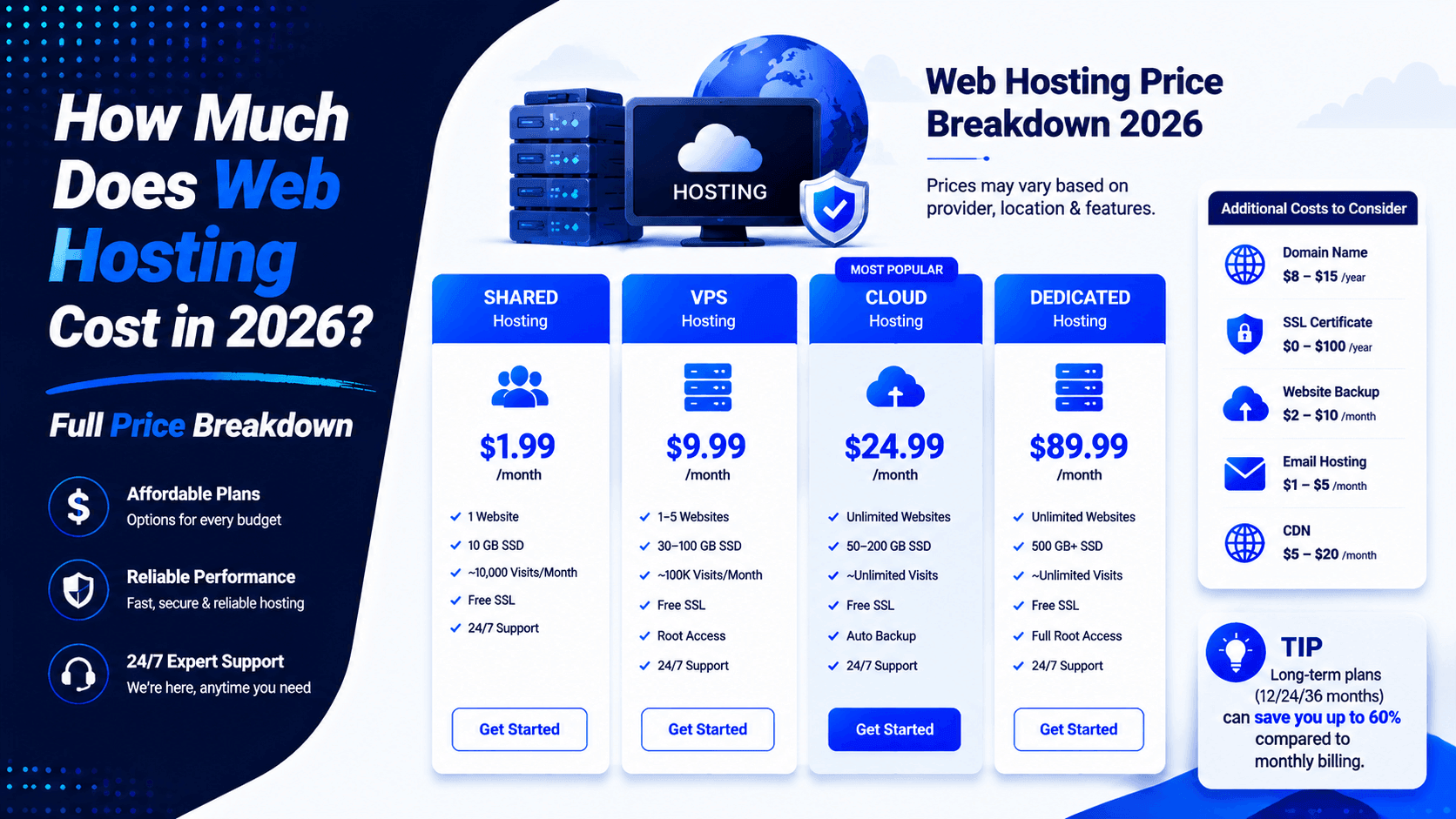
The fastest way to understand hosting prices is to look at the main hosting types side by side. In 2026, the lowest entry prices still sit in shared hosting. Premium managed platforms, cloud systems, and dedicated machines cost much more. That gap is normal because you are paying for more power, more support, or both.
Quick Price Overview Table
| Hosting Type | Common Entry Price | Higher-End Range | Best For |
|---|---|---|---|
| Shared hosting | $2.99–$7.99/mo | $10–$15+/mo | Blogs, portfolios, small sites |
| WordPress hosting | $7.99–$30/mo | $55–$276+/mo | WordPress sites that need easier management |
| VPS hosting | $4–$5/mo | $30–$100+/mo | Growing sites, apps, online stores |
| Cloud hosting | $5–$8/mo | $100–$300+/mo | Scalable sites and changing traffic |
| Dedicated server | $70–$98/mo | $300–$500+/mo and up | Large, high-traffic, or custom workloads |
| Reseller hosting | about $19.88/mo | $40–$60+/mo | Agencies, designers, hosting resellers |
These numbers come from public starter prices. Providers include Hostinger, SiteGround, WP Engine, Kinsta, DigitalOcean, AWS Lightsail, IONOS, OVHcloud, Namecheap, and InMotion/Namecheap reseller plans. Your real total may go up after renewal. Add-ons can also raise the final cost.
Why Prices Change So Much Between Hosts
Two plans can both say “hosting,” yet feel nothing alike. One may run on basic shared resources. Another may include fast NVMe storage, a CDN, daily backups, staging, and expert support. That is why price alone tells only part of the story.
Renewal pricing is another big reason for the gap. Hostinger’s Premium plan is shown at $2.99 per month on a long term, but renews at $10.99 per month. Its Business plan is shown at $3.99 per month and renews at $16.99 per month. SiteGround’s WordPress hosting page shows $7.99 per month and says it renews at $44.99 per month on a 12‑month prepaid term. This is why cheap web hosting can look cheaper than it really is.
Factors That Affect Web Hosting Costs
The price of a hosting plan usually depends on six key factors. These are hardware, traffic limits, performance tools, support, security, and how much work the provider handles for you. Once you understand these, comparing prices becomes much easier.
Server Resources
More CPU power, more RAM, and faster storage all increase the price. A simple blog can run well on a small shared plan. But an online store or app often needs more memory and stronger processors. Take Hostinger’s plans as an example. Their Premium plan gives you 1 CPU core and 2 GB RAM. Their Cloud Startup plan offers 4 CPU cores and 4 GB RAM. The price goes up with that jump in resources.
Storage Type and Size
Storage is not just about how much space you get. Speed matters just as much. Some plans still use standard SSD drives. Others promote NVMe storage, which offers faster read and write performance. Hosts charge more when they provide faster storage or much larger storage pools.
Bandwidth and Traffic
Low-cost plans may work fine until your site gets real traffic. After that, resource pressure becomes the real problem. Managed WordPress hosts often link their plans to monthly visits. WP Engine’s Startup plan allows 25,000 visits. Their higher plans raise that limit along with storage and bandwidth.
Performance Features
Caching tools, CDN services, image delivery, and built-in optimization can push the price up. Kinsta, for instance, promotes built-in CDN, advanced caching, backups, uptime monitoring, SSL, and security features as part of their plan value. This helps explain why managed platforms cost more than basic shared hosting.
Security Features
Free SSL certificates are now common. Let’s Encrypt provides free and automated TLS certificates. But not every host includes the same level of protection beyond SSL. Malware protection, DDoS defense, threat monitoring, and managed firewalls can raise the real cost you pay.
Managed vs. Unmanaged Service
This is one of the biggest price drivers. A self-managed VPS costs less because you do more of the work. A managed platform costs more because the host handles updates, backups, monitoring, migrations, and support. Cloudways markets managed WooCommerce hosting from $22 per month. A basic self-managed VPS can start much lower on providers like DigitalOcean or Lightsail.
Shared Hosting Costs in 2026
Shared hosting remains the cheapest option for most new site owners. It is built for users who want simple setup and low monthly costs. That makes it a common choice for blogs, portfolios, brochure sites, and first business websites.
Who Shared Hosting Is Best For
A small site with light traffic usually works well on shared hosting. If you are building a personal site, a small local business page, or a simple service site, this is often enough. It is also a smart starting point when your site is new. You may not yet know how much traffic you will get.
Typical Shared Hosting Pricing
Current promo pricing shows how low the market can go. Hostinger lists Premium at $2.99 per month. Bluehost shows web hosting starting at $3.99 per month on its pricing page. SiteGround’s WordPress entry price is higher at $7.99 per month. These numbers give a good snapshot of where entry-level shared hosting sits in 2026.
What you get at this level varies. Hostinger’s Premium plan includes up to 3 websites, 20 GB SSD storage, free SSL, weekly backups, and a free domain for one year on qualifying terms. That is solid value for a starter plan. But it is still a low-resource environment compared with VPS or cloud hosting.
Hidden Renewal Costs
This is where many buyers get surprised. A low shared-hosting price is often a first-term price only. Hostinger clearly shows its renewal jump from $2.99 to $10.99 per month. SiteGround also shows a much higher renewal rate than its starting price. Always compare the first bill and the later bill before choosing a plan.
Pros
- Low cost
- Easy setup
- Good for beginners
- Often includes free SSL and a domain for year one
Cons
- Shared resources
- Less stable performance during traffic spikes
- Less server control
- Renewal pricing can be much higher
WordPress Hosting Costs in 2026
WordPress hosting covers a wide range. Some plans are just shared hosting with WordPress tools. Others are fully managed platforms built only for WordPress.
Managed WordPress Hosting Pricing
Here is a cleaner look at current public examples:
| Provider | Starting Price | Notes |
|---|---|---|
| Hostinger | $2.99/mo | Entry plan, WordPress-ready, shared environment |
| SiteGround | $7.99/mo | Managed WordPress angle, renews at $44.99/mo |
| Kinsta | $30/mo | Premium managed WordPress hosting |
| WP Engine | $30/mo | Managed WordPress Startup plan |
These prices show why the phrase “WordPress hosting” can be misleading. It depends on how each host defines it. One host uses it for budget-friendly shared hosting. Another uses it for a premium managed platform. That platform includes staging, caching, CDN, security, and expert support.
What Is Usually Included
Managed WordPress hosting often includes several key features. These are automatic updates, backups, staging sites, and security monitoring. You also get support from WordPress specialists. CDN tools and better caching are typically included too.
WP Engine lists daily and on-demand backups, SSL, DDoS protection, staging, EverCache, and technical support. Kinsta highlights CDN, caching, backups, uptime monitoring, SSL, DDoS protection, and engineer-level support.
Is Managed WordPress Hosting Worth It?
For a hobby blog, maybe not. For a business site, agency build, or revenue site, it often is. You pay more, but you save time and lower risk. If downtime hurts revenue or client trust, the higher monthly bill can make sense.
VPS Hosting Costs in 2026
VPS hosting is where many growing sites move next. It gives you more control and more predictable resources than shared hosting.
Entry-Level VPS Plans
DigitalOcean says its lowest-cost VPS hosting starts at $4 per month. AWS Lightsail shows Linux/Unix bundles starting at $5 per month with public IPv4. IPv6-only bundles start at $3.50 per month. These prices make VPS more reachable than many people expect.
Business VPS Pricing
Once you move into stronger VPS plans, the price rises quickly. DigitalOcean’s general-purpose droplets start at $63 per month for 8 GB memory, 25 GB SSD, and 4 TB transfer. CPU-optimized droplets start at $42 per month. This is the zone where serious stores, apps, and busy business sites often land.
Managed VPS vs. Self-Managed VPS
A self-managed VPS is cheaper because you handle setup, updates, patches, and recovery. A managed VPS costs more because the provider does that work for you. Cloudways is a good example of managed infrastructure built on cloud providers. Their WooCommerce hosting starts at $22 per month for a managed 2 GB DigitalOcean server.
Best Use Cases
VPS works well for:
- Growing business websites
- Busy blogs
- Membership sites
- Medium online stores
- Custom apps that need server access
Cloud Hosting Costs in 2026
Cloud hosting can mean two different things. It can mean a fixed monthly cloud server. Or it can mean a usage-based platform that bills as you consume resources.
Pay-As-You-Go and Fixed Bundles
AWS Lightsail uses simple monthly bundles. That makes it easier for beginners to estimate cost. Other cloud tools, such as container or serverless platforms, can be more usage-based. The upside is flexibility. The downside is that the bill can be less predictable if traffic suddenly jumps.
Monthly Cloud Hosting Costs
At the low end, Hostinger’s Cloud Startup plan is listed at $7.99 per month on promo pricing. AWS Lightsail starts at $5 per month for a public-IPv4 Linux instance. On the higher side, cloud servers can move into the $100 to $300 range or more. CPU, RAM, bandwidth, and storage all go up with the price. Lightsail’s larger plans go far beyond entry pricing.
Scalability Benefits
The main reason people choose cloud hosting is room to grow. You can add power more easily than on basic shared hosting. That helps when traffic changes often. This is useful for launches, promotions, news spikes, or seasonal traffic.
Popular Cloud Pricing Examples
- AWS Lightsail Linux with public IPv4 starts at $5/mo
- Hostinger Cloud Startup starts at $7.99/mo
- Cloudways managed WooCommerce starts at $22/mo
- DigitalOcean cloud VPS starts at $4/mo
These are very different products. But they show the current cloud pricing spread well.
Dedicated Server Hosting Costs in 2026
A dedicated server gives you a full physical machine. Nothing important is shared. That gives you maximum control, isolation, and raw power.
Entry-Level Dedicated Servers
Official provider pages show clear starting prices. IONOS dedicated servers begin at $70 per month. OVHcloud offers Game dedicated servers from $79. Their Advance dedicated servers start at $98. True dedicated hosting no longer starts in the hundreds for every case. However, stronger setups still get expensive fast.
Enterprise Dedicated Hosting
Prices climb sharply for high-core servers. They also rise for large RAM pools. Advanced storage arrays add more cost. OVHcloud shows Scale dedicated servers at much higher pricing tiers. Dedicated server hosting is mainly for large projects. It is not meant for small sites.
When Dedicated Hosting Makes Sense
Choose it when you need one or more of these:
- Very high traffic
- Heavy database work
- Strong compliance or isolation needs
- Custom hardware needs
- Full control over the stack
Additional Hosting Costs You Should Expect
The hosting plan is not the whole budget. A full site almost always needs a few other paid items.
Domain Registration Fees
A domain usually adds another yearly cost. Namecheap shows a .com at $10.28 for the first year, .org at $7.48, and .net at $12.98 at the time of the pricing snapshot. It also says domain privacy is included free for life on listed domains.
SSL Certificates
This part is better than it used to be. Let’s Encrypt offers free, automated TLS certificates. That means many hosts now include a free SSL certificate by default. If a host still tries to upsell a basic SSL for a simple site, compare carefully before you pay.
Control Panel Costs
This fee matters more on VPS and dedicated plans. cPanel now lists Solo at $29.99 per month, Admin at $35.99, Pro at $53.99, and Premier at $69.99 per month. So if your VPS plan looks cheap, but cPanel is extra, the real monthly cost may jump fast.
Backups, Email, and CDN Tools
Some hosts include backups and CDN tools. Others do not. Hostinger includes weekly backups on Premium. They include daily backups on Business. Kinsta and WP Engine offer richer built-in backup tools. They also include performance tools. These come as part of their managed service. Email may be limited. It may also be bundled only for part of the term.
Hidden Hosting Fees to Watch Out For
A low sticker price can hide a high real price.
Higher Renewal Rates
This is the most common trap. Hostinger and SiteGround both show clear gaps between intro pricing and renewal pricing. If you only compare the first invoice, you may choose the wrong plan for the long run.
Control Panel Upsells
As noted above, cPanel adds a serious monthly charge. This applies to unmanaged servers. It matters a lot for agencies and resellers. Licensing scales up with account needs. More accounts mean higher cPanel costs.
Feature Upsells at Checkout
Many providers sell extras during checkout. These may include security tools. They may include email upgrades. They may include backups, domain extras, privacy tools, or migration services. Some are useful. Many are optional. Read each one before paying. Do not click through without checking.
How to Choose the Right Hosting Plan for Your Budget
The best plan is not the cheapest plan. It is the lowest-cost option that still fits your site well.
Personal Blogs
For a new blog, shared hosting is usually enough. A promo-priced plan from Hostinger works well. Other similar entry plans also work. The goal is low cost, free SSL, and easy setup. That is all a new blog really needs.
Small Business Websites
A service business site often does well on quality shared hosting. Low-end managed WordPress hosting also works well. The sweet spot is better support and stronger backups. Decent speed matters too. You do not need expensive infrastructure yet.
eCommerce Stores
Stores need better performance. They also need better support. A managed WooCommerce platform is a smart choice. A good VPS or cloud setup also works well. These beat the cheapest shared hosting plan. Cloudways starts WooCommerce hosting at $22 per month. This shows the entry point for managed store hosting.
Agency and Client Sites
Agencies need room for many sites. They need client isolation too. White-label tools are often required. Reseller hosting or VPS plans are common here. Namecheap’s reseller plans begin at $19.88 per month. This gives a clear entry point for this part of the market.
High-Traffic Websites
If a site gets very heavy traffic or runs demanding apps, look at strong cloud setups or a dedicated server. That is where predictable resources matter more than low intro pricing.
Example Hosting Budgets for Different Website Types
These are practical budget ranges. They come from current public pricing. They are not made-up wish lists.
Beginner Blog Budget
A starter site often stays near $50 to $120 per year. That covers low-cost hosting and a domain. The total changes based on renewal timing. It also changes if the domain is free in year one.
Small Business Website Budget
A small business site often lands around $100 to $300 per year. It uses quality shared hosting and a domain. It may include business email. It may include a better backup setup. The number goes up with premium themes. Paid tools also add cost.
Online Store Budget
A serious store usually starts higher. A realistic range is $250 to $1,000+ per year. It depends on hosting type and plugin stack. It also depends on backups and support level. Managed WooCommerce raises the budget. Premium WordPress hosting also costs more. But it can save time. It can also reduce risk.
Enterprise Website Budget
Large sites can move well past $1,000 per year and often much higher. Dedicated servers alone can start around $70 to $98 per month before add-ons.
Ways to Save Money on Web Hosting in 2026
Saving money is not hard if you avoid the obvious traps.
Choose Longer Billing Cycles
Long prepaid terms usually lower the monthly rate. Hostinger’s promo pricing is tied to a long term, which is why the monthly number looks so low.
Avoid Add-Ons You Do Not Need
Free SSL is already easy to get through Let’s Encrypt. Some hosts also include backups, CDN, or migrations. Do not pay twice for what is already bundled.
Use Intro Offers Carefully
Promo pricing is useful if you understand the renewal rate too. If you do not, it can backfire.
Start Small and Upgrade Later
A new site does not need a dedicated server. Start where your traffic and budget are today. Upgrade when the site proves it needs more.
Common Web Hosting Pricing Mistakes
Most overpaying happens because people rush the first choice.
Choosing Only by Price
The cheapest number on the page can be misleading. It may be missing backups. It may lack support or speed tools. Enough resources might not be included either. A slightly higher plan can be a better long-term deal.Ignoring Renewal Pricing
This is still the biggest mistake in hosting. Always check the renewal line before you buy.
Paying for More Power Than You Need
A simple portfolio does not need a dedicated server. A brand-new blog usually does not need a premium managed platform either.
Not Checking Support Quality
When something breaks, support matters more than ad copy. Premium hosts charge more partly because they give deeper technical help. Kinsta and WP Engine both market 24/7 expert support as a core part of their price.
Frequently Asked Questions
What is the cheapest web hosting in 2026?
Shared hosting is still the cheapest category. It works for standard website plans. Hostinger shows entry hosting at $2.99 per month on promo pricing. For low-cost VPS-style cloud servers, DigitalOcean starts at $4. AWS Lightsail starts at $5 with public IPv4.
How much should a small business spend on hosting?
A small business site often does well in the $100 to $300 per year range. It depends on hosting quality and domain cost. It also depends on whether email, backups, or premium tools are included.
Is cloud hosting more expensive than shared hosting?
Usually yes. Shared hosting has the lowest entry cost. Cloud hosting offers more flexibility and growth room, so it usually costs more.
Are free hosting services worth it?
They can work for testing, but they are rarely the best choice for a serious website. Business sites need better stability, better support, and stronger control.
How much does hosting cost for an online store?
A real store often lands around $250 to $1,000+ per year. It depends on traffic and support needs. It also depends on security needs. Managed ecommerce hosting raises the cost too.
Conclusion
Web hosting cost in 2026 depends on several factors. Your website’s size matters. Traffic levels matter too. Features and hosting type also play a role.
Shared hosting is a budget-friendly option. It works well for blogs and small websites. VPS, cloud, and dedicated hosting provide more power. They also offer better scalability.
Before choosing a plan, compare renewal prices. Check storage limits. Look at backup options. Review SSL and support. See what upgrade options exist.
The cheapest plan is not always the best value. Think about long-term costs. Think about performance needs.
Choose the right hosting plan today. Get reliable performance without overspending.

Leave a Comment