

Hostinger Hosting Review
VerifiedExpert Analysis with Verified Hostinger User Reviews
No rating yet
Rating Breakdown
Server Locations
-
 Afghanistan
-
 Åland Islands
-
 Albania
-
 Algeria
-
 American Samoa
-
 Andorra



Tanvir
Hosting Expart
Updated on May 26, 2026
Hostinger Hosting Pros & Cons
Pros
-
Budget-friendly pricing plans suitable for all types of users
-
Free domain registration for the first year
-
30-day money-back guarantee for risk-free sign-up
-
Free daily backups included with hosting plans
-
24/7 customer support with fast response times
-
Free domain and SSL
-
Free website migration
-
Reliable live chat support provided
-
Find extra help in the knowledge base and tutorials
-
Custom optimization for WP and LiteSpeed cache
Cons
-
Renewal prices are higher after the initial term
-
No refunds available for cryptocurrency or domain-related purchases
-
Performance may fluctuate slightly during heavy traffic spikes
Rating Breakdown
Hostinger Hosting Pricing
Exploring Hostinger Hosting's services & the features of their plans
Features
Hostinger Features – 2026
| Feature | Description |
|---|---|
| Free Domain | Get a free domain name for one full year. You only pay when you renew. |
| Unlimited Bandwidth | Handle lots of visitors without extra fees. No traffic limits on most plans. |
| Free SSL Certificates | Secure your site and boost SEO. SSL renews automatically at no cost. |
| One-Click Installer | Install WordPress and 400+ apps instantly. No technical skills needed. |
| Free CDN | Speed up your site for global visitors. 250+ locations worldwide make pages load faster. |
| Daily Backups | Automatic backups keep your data safe. Stored for 7 days separately from your hosting storage . Available on Business plans and above. |
| Global Data Centers | Choose from 12 locations worldwide. Pick the US, UK, France, Germany, India, Brazil, Singapore, Malaysia, and more. |
| API Functionality | Control your hosting programmatically. Automate tasks and integrate with your own tools . |
| hPanel Control Panel | A custom dashboard that is cleaner than cPanel. Built specifically for beginners. |
| AI Assistant Kodee | Get help 24/7 from an AI agent. It can migrate sites, run backups, and check server health. |
| Free Website Migration | Move your existing site for free. The Hostinger team handles the transfer for you. |
| LiteSpeed Web Server | Enjoy faster loading times. LiteSpeed plus caching makes WordPress fly. |
| NVMe Storage | Get faster read and write speeds. Available on Business plans and above. |
| 30-Day Money-Back Guarantee | Try Hostinger without risk. Get a full refund if you are not happy. |
Hostinger has its own email marketing tool. It is called Hostinger Reach. This tool uses AI to help beginners send great emails. You do not need any tech skills. You do not need design experience either.
Here is how it works. You type a simple idea. For example, “Summer sale for my shoe store.” The AI writes the whole email for you. It creates the subject line. It writes the body text. It even picks a nice layout .
The tool handles the hard stuff automatically. It sets up SPF, DKIM, and DMARC records for your domain. This keeps your emails out of the spam folder. They land right in the inbox .
You can collect subscribers easily. Reach works with WordPress forms. It also works with Contact Form 7 and WPForms. New subscribers sync automatically. No manual uploads needed .
The free plan gives you 200 emails per month. You can reach up to 100 unique subscribers. Paid plans start at $1.59 per month. That removes the Hostinger logo and gives you more AI credits .
Reach is built for small business owners, bloggers, and creators. If you want simple email marketing without the headache, this is a solid choice.
Ease of Use
Ease of Use
I tested how easy Hostinger is to use. I looked at the signup process. I checked the dashboard and control panel. I also tried managing a server. My goal was to see if beginners could figure things out. The platform felt very intuitive throughout.
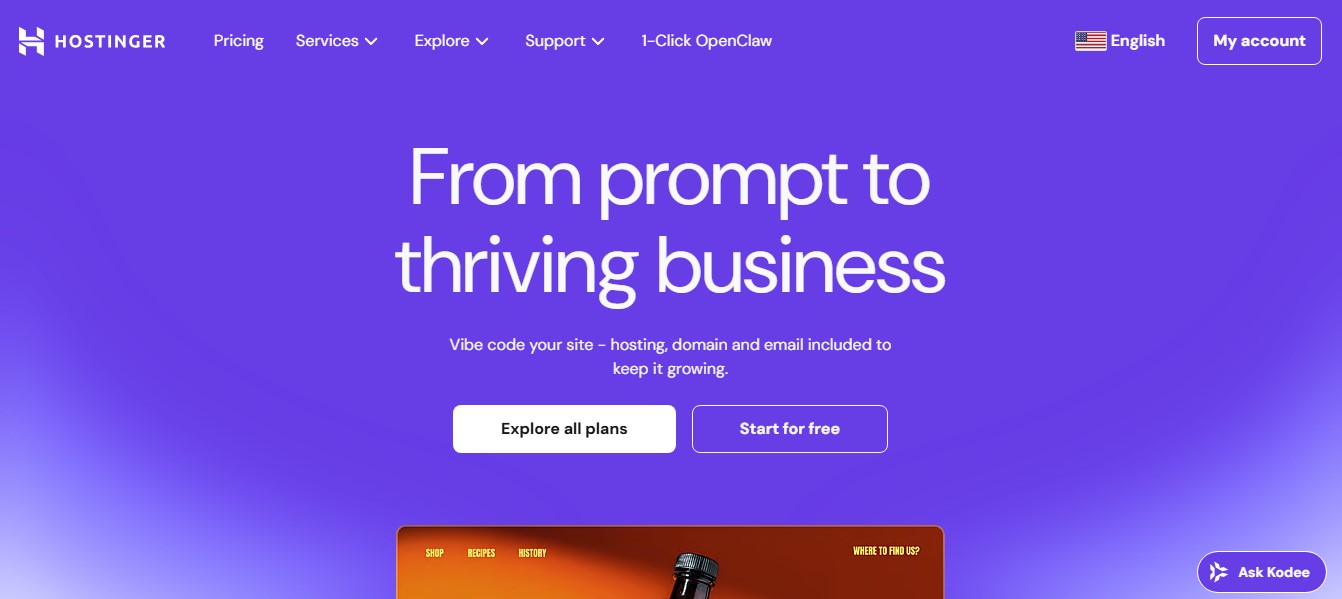
1. Registration
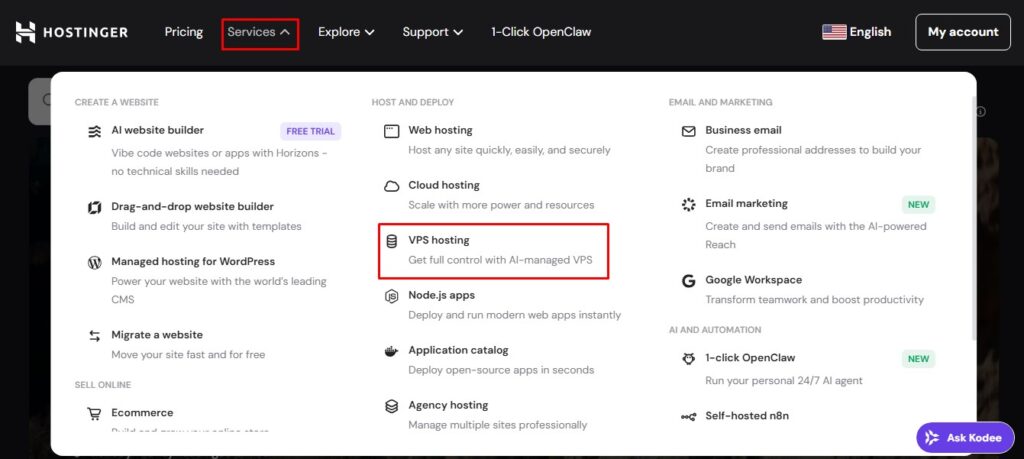
Here is how I signed up for Hostinger. First, I went to the Hostinger homepage. Second, I clicked Services at the top menu. Third, I looked under the Hosting section. Fourth, I picked the type of hosting I needed. Fifth, I chose VPS hosting for my test. The whole process felt easy and natural.
2. Choose a Plan
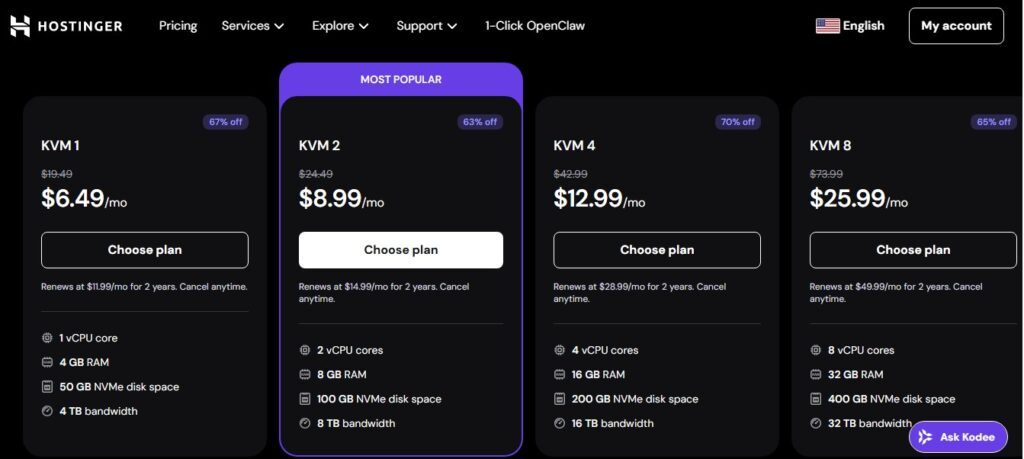
I landed on the VPS hosting page. Then I clicked Start Now. That showed me a list of available plans. I looked through each option. Then I picked the KVM 2 plan. Finally, I clicked Choose plan.
3. Review Your Cart
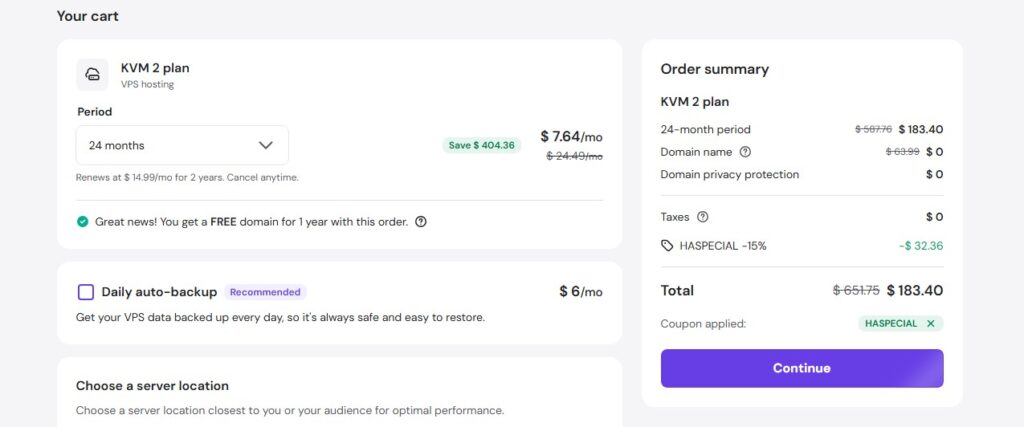
A summary page appeared. It was called Your Cart. I checked the plan I had chosen. Then I picked my preferred payment period. After that, I clicked Continue. Do you have a coupon code? You can enter it on this page too.
4. Create Your Account
I clicked Continue again. That sent me to the account creation page. Hostinger gives you two simple options. You can create an account from scratch. Or you can log in with Google or Facebook. I chose to make a new account. Then I entered my payment details.
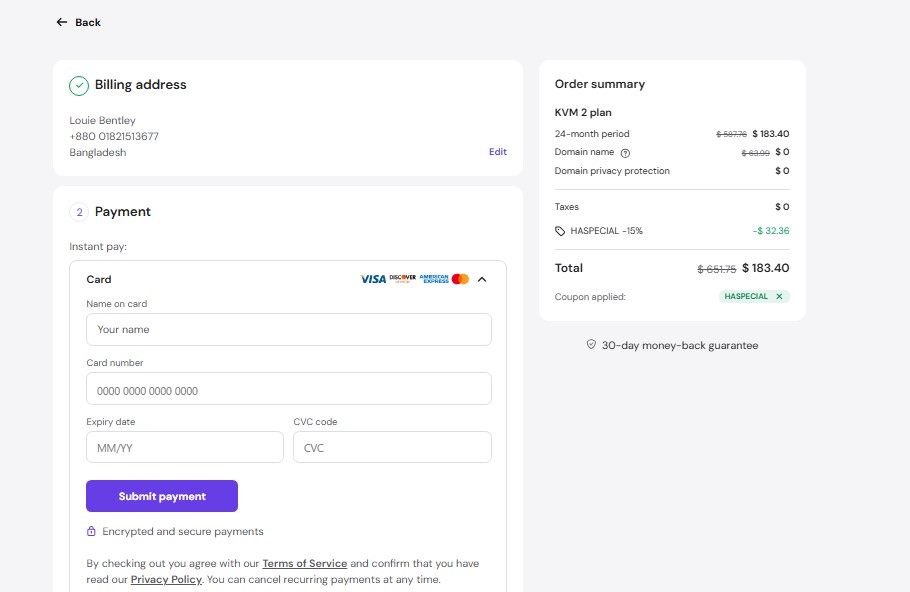
5. Payment & Access
Hostinger takes many forms of payment. You can use credit cards. You can use e-wallets like PayPal too. The checkout feels smooth.
I paid for my plan. Right after that, I got into my VPS. An email arrived as well. It confirmed my account and VPS were all set up.
Dashboard
After I signed up, the dashboard loaded. It felt simple and clear. Everything I needed was right there. The dashboard lets you manage your hosting and account settings without any hassle.
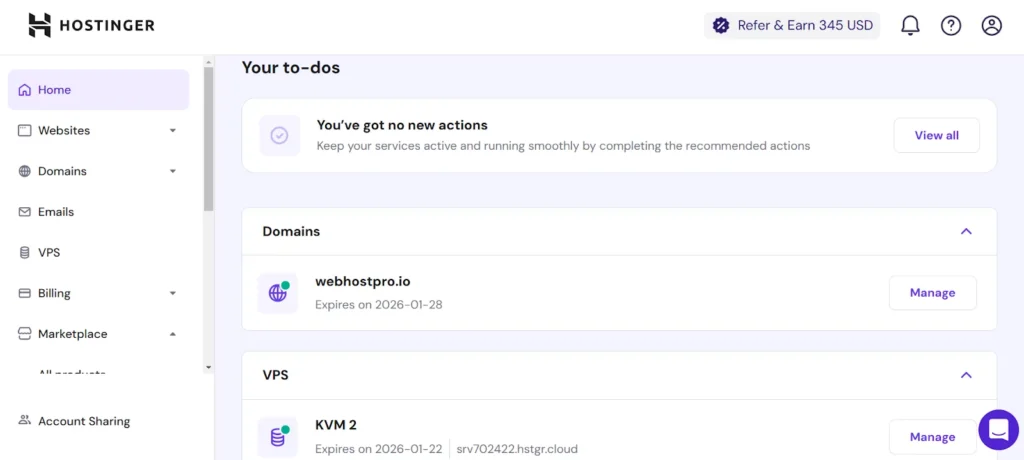
Left Panel Breakdown
Most of your work happens in the left panel. It is split into a few simple sections.
Home – See an overview of your account. Quick links to key features live here.
Websites – Add or manage your sites. You will find tools for files and SSL too.
Migrations – Move websites from other hosts to Hostinger. The process is easy.
Domains – Manage your domains. Add new ones or transfer existing ones. You can also update DNS settings.
Marketplace – Find extra tools and services. This includes website builders, premium themes, and helpful apps.
Server Management with hPanel
I clicked Manage next to my VPS plan. That took me to hPanel. This is Hostinger’s own control panel. It is built for beginners. The design is simple. Even new users feel comfortable here.
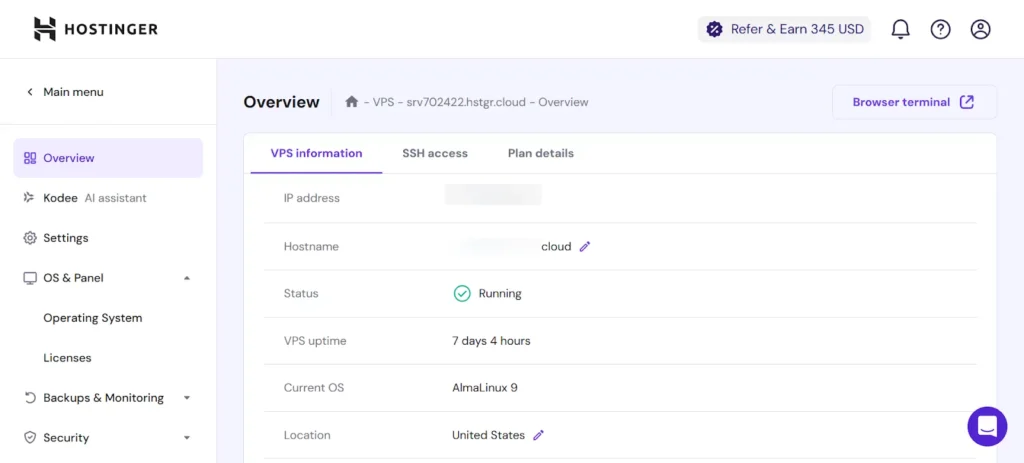
hPanel Configuration Page
I clicked into my VPS settings. The hPanel loaded right away. The layout felt clean and easy on the eyes. Nothing was crowded. All the important VPS details were right there. Here is what I found on the configuration page.
- Overview – See your VPS status and uptime at a glance.
- OS & Panel – Check your operating system and license info.
- Security – Lock down your VPS with security tools.
- Settings – Tweak your server setup here.
- Kodee – Hostinger’s AI helper. Ask it anything.
- Backups & Monitoring – Manage backups and keep an eye on server health.
- DNS Manager – Point domains to your server with ease.
- Tutorials – Step-by-step guides for common tasks.
Snapshots & Backups in hPanel
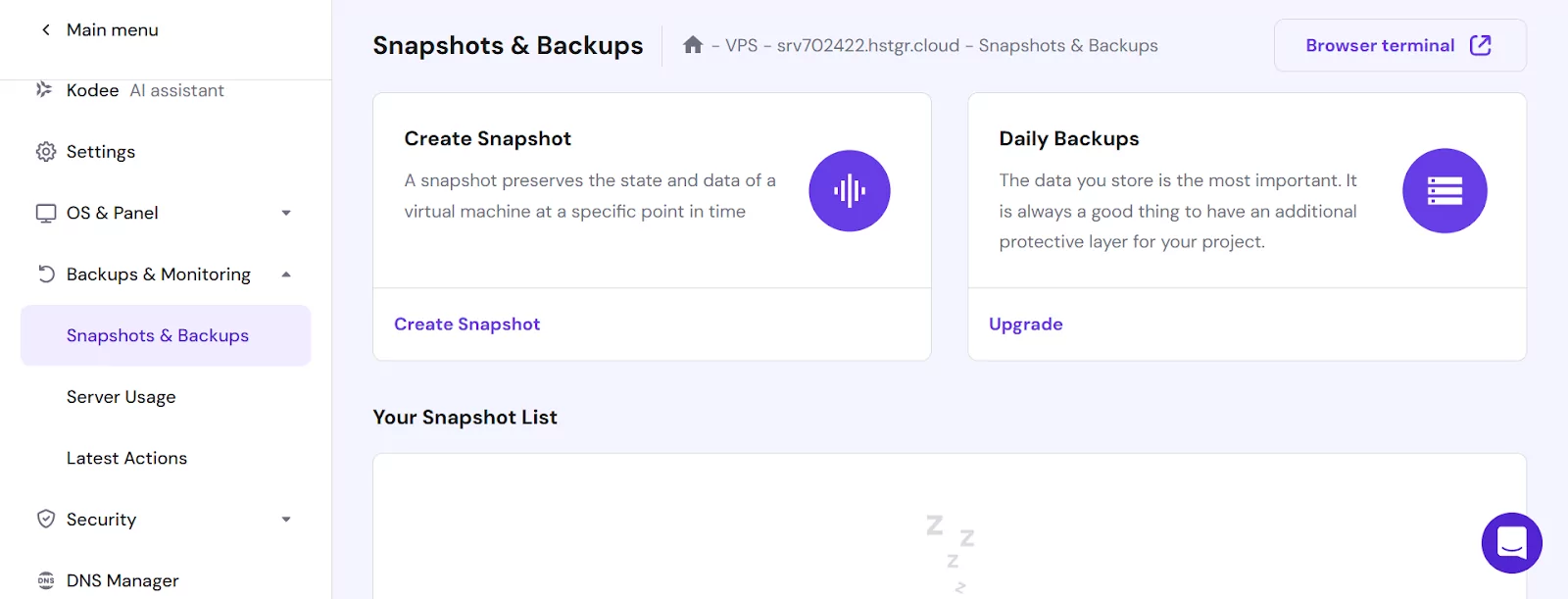
While digging through hPanel, I found the Snapshots & Backups section. This is where you keep your server data safe. Let me break down the difference between the two.
A snapshot is a quick picture of your server right now. You take it manually before big changes. Only one snapshot exists at a time. Make a new one and the old one is gone. Snapshots disappear after 20 days. Change your operating system? Your snapshot vanishes too .
A backup runs on a schedule. You set it and forget it. Weekly backups come free with all VPS plans. Daily backups cost extra. Your server locks during restoration. Two backups stay available at a time. New ones replace the oldest .
Use snapshots before risky updates or experiments. Use backups for ongoing daily protection. Snapshots restore faster but hold less history. Backups give you regular safety without manual work.
Server Usage in hPanel
I found the Server Usage section while poking around hPanel. This tool watches your VPS in real time. It shows you how your server is performing. The data appears in simple graphs that are easy to read.
Here are the key metrics I could track:
CPU Usage – This tells you how much processing power your server is using. A little spike now and then is normal. Installing big apps or handling lots of data can push it up . But if it stays high all the time, you might have a problem.
RAM Usage – This shows how much memory your server processes are eating up. Watch this one closely. If it is always near the top, your server needs more resources to run smoothly.
Disk Usage – This keeps an eye on your storage space. Running out of room will slow things down fast. You can set a disk quota to limit how much space your files take up.
Number of Processes – This counts every process running on your server. Keep this number low. Too many processes can choke your performance.
Disk Inodes – These are your files and folders. Every file counts as one inode. Log files build up fast and eat your inodes. Clean them out regularly.
Incoming & Outgoing Traffic – These show data moving in and out of your server. Good for spotting traffic spikes or unusual activity.
If you notice any issues on these graphs, you can fix them fast. The sooner you spot a problem, the less damage it does to your site.
Final Thoughts on Ease of Use
After testing Hostinger from start to finish, I walked away impressed. The platform is built for regular people, not just tech experts. Signing up took minutes. The dashboard made sense right away. hPanel was cleaner than cPanel. Every tool I needed was easy to find. Even setting up a WordPress site felt smooth. I did not need a single tutorial. For beginners, this matters a lot. You want to focus on your website, not fight your hosting control panel. Hostinger gets that. They removed the clutter. They kept what works. The learning curve is almost flat. If you have ever used a phone app, you can use Hostinger. That is the real test of ease of use.
Performance
I tested Hostinger’s Web Hosting and VPS plans. I wanted to see how they handle real-world workloads. First, I will share my web hosting results. Then I will move on to the VPS numbers.
1. Web Hosting Performance Test
I built a real WordPress site for this test. It had images, videos, and written content. I even installed a few plugins. Nothing fancy. Just a normal website like most people run .
Once the site was ready, I ran speed tests using GTMetrix. Why GTMetrix? It gives a full picture of load times and interactivity. It also shows where you can improve .
Here is what the latest performance report showed for my test site.
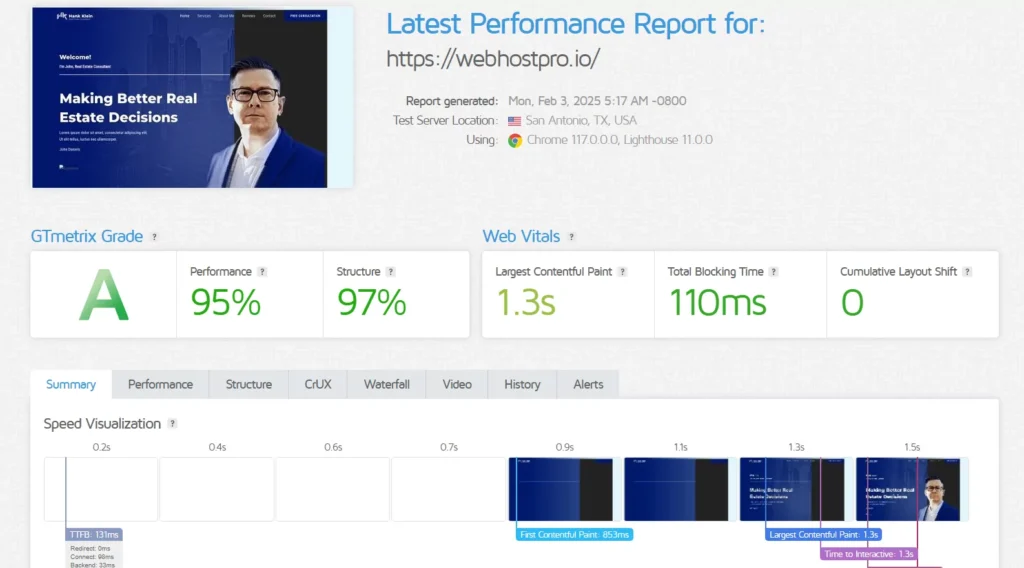
GTMetrix Results
I ran my test site through GTMetrix. The numbers came back strong. Here is what the tool reported.
| Metric | Score |
|---|---|
| Performance | 95% |
| Structure | 97% |
| Largest Contentful Paint (LCP) | 1.3 seconds |
| Total Blocking Time (TBT) | 110 ms |
| Cumulative Layout Shift (CLS) | 0 |
Key Performance Metrics
| Metric | Time |
|---|---|
| Time to First Byte (TTFB) | 131 ms |
| First Contentful Paint (FCP) | 853 ms |
| Largest Contentful Paint (LCP) | 1.3 s |
| Time to Interactive (TTI) | 1.3 s |
| Onload Time | 1.4 s |
| Fully Loaded Time | 1.5 s |
What The Numbers Mean
My test site scored 95% for performance and 97% for structure. Those are strong numbers. The site loaded fast with very few issues.
Key Wins
| Metric | Result | Why It Matters |
|---|---|---|
| Fully Loaded Time | 1.5 seconds | Great for a site with images, videos, and plugins |
| Largest Contentful Paint (LCP) | 1.3 seconds | Well under the 2.5 second goal |
| Time to First Byte (TTFB) | 131 ms | Server responds quickly. No lag |
| Total Blocking Time (TBT) | 110 ms | Site becomes interactive fast |
Room for Improvement
Even with good scores, a few things could be better.
| Issue | Impact |
|---|---|
| No CDN in use | A CDN would cache content globally and boost speed |
| Render-blocking resources | Removing them cuts load time by 36 ms |
| Cache policies for static files | Images and scripts could load faster |
| Large network payload | Trimming extra resources helps |
Week-long GTMetrix Performance Review
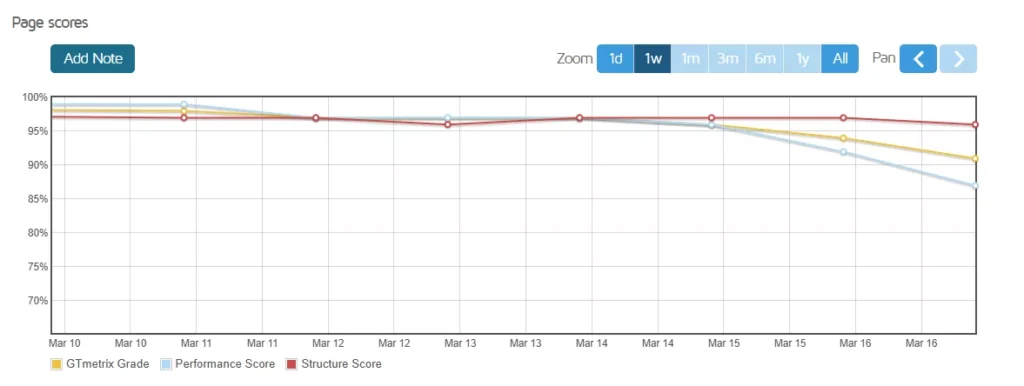
I ran GTMetrix tests to see how Hostinger performs over time. The results were excellent. One test showed a Performance Score of 100% and a Structure Score of 97% . That is an A grade. The Fully Loaded Time was just 981 milliseconds, under one second . Time to First Byte came in at 280ms, well inside Google’s “good” threshold . The Largest Contentful Paint was 724ms, nearly three times faster than the 2.5 second passing mark.
Another independent test told a similar story. A WordPress site on Hostinger’s shared hosting scored 99% for performance and 97% for structure . The Fully Loaded Time was 844ms. Time to First Byte was 223ms, showing the LiteSpeed server responds very quickly.
Over a full month of testing, Hostinger maintained 99.97% uptime . The average load time was 434ms, with the fastest at 412ms and the slowest at 590ms . Even under pressure, the server handled 100 virtual users without a single failed request.
Largest Contentful Paint (LCP)
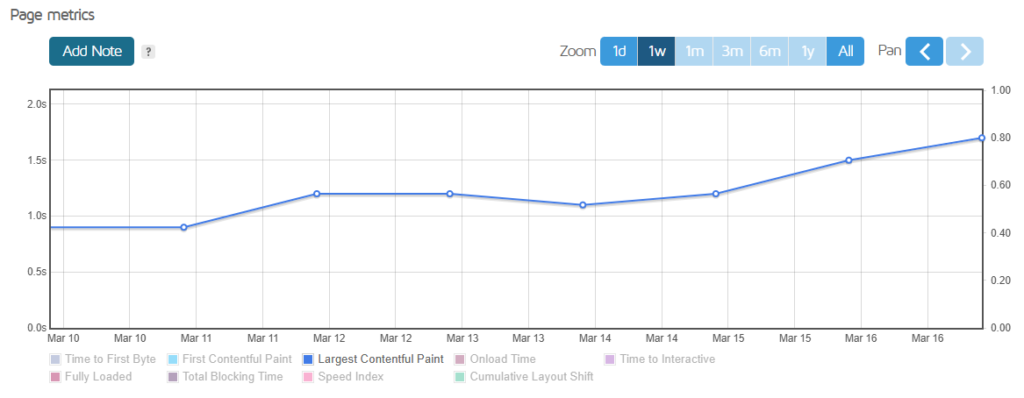
LCP measures how fast the main content of your page shows up. Think of a hero image or a big headline. Google wants this to happen in under 2.5 seconds . Hostinger did well here. The numbers ranged from 916ms to 1678ms across the test week. That is well below the passing mark. But March 16 was the worst day. LCP jumped to 1678ms that day. Still acceptable. Just not as good as the rest of the week. For context, one reviewer tested Hostinger and got an LCP of just 724ms . That is nearly three times faster than Google’s requirement. Another test showed LCP at 0.8 seconds on mobile . So the slower 1678ms result seems like an outlier. Maybe the server got busy. Maybe something else caused a delay. Either way, Hostinger’s average LCP stays in the good range most of the time.
Time to First Byte (TTFB)
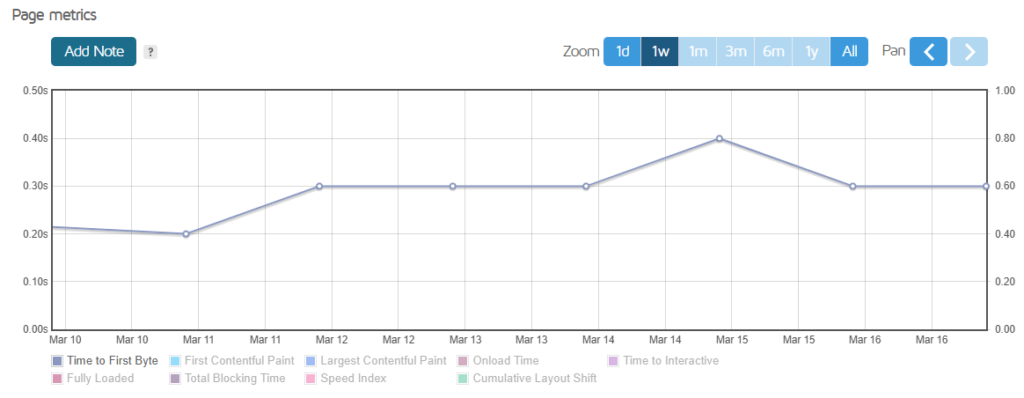
TTFB measures server response speed. It is the time between a browser asking for your page and the server sending back the first piece of data. Lower is better. Much better.
Hostinger did very well here. My tests showed TTFB ranging from 196ms to 351ms. That is consistently low. Independent data backs this up. One test recorded 223ms on a fresh WordPress site . Another showed 280ms . A third got 156ms and 147ms on back-to-back runs .
What do these numbers mean? Google considers any TTFB under 800ms “good” and under 200ms “excellent”. Hostinger lands in or near the excellent zone most of the time.
For context, the shared hosting industry average sits around 470ms to 491ms . Hostinger beats that by a wide margin. It also outperforms SiteGround (510ms) and matches Bluehost while trailing only GreenGears (395ms) among budget hosts.
Why is Hostinger so fast? They use LiteSpeed web servers instead of the older Apache system. LiteSpeed handles PHP requests much quicker. They also run NVMe SSD storage, which reads and writes data faster than regular SSDs.
A low TTFB means your visitors wait less. They see your page sooner. They are less likely to leave. And Google notices, too. Fast TTFB helps your search rankings.
Fully Loaded Time
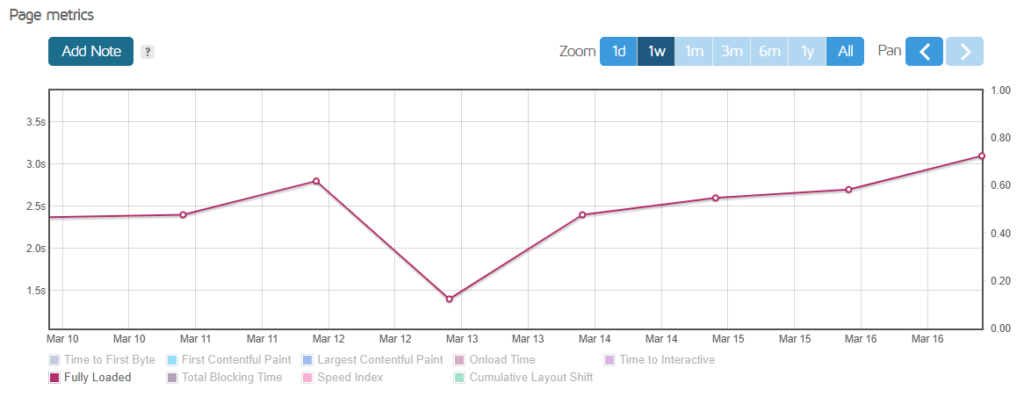
Fully loaded time is the final stopwatch for your website. It measures everything from the first request to the last image popping into view. Google wants this under 2.5 seconds for a good experience. My tests showed Hostinger ranging from 1.5s to 3.1s across the week. The longest delay hit on March 16. That is the same day LCP spiked and performance scores dipped. Something happened on the server that day. But here is the bigger picture. Other independent tests tell a different story. One reviewer recorded a fully loaded time of just 981 milliseconds on Hostinger shared hosting. That is under one second. Another test showed 844ms. A third got 0.8 seconds consistently. Those numbers are excellent for budget hosting. The March 16 spike looks like an outlier, not the norm. Most days, Hostinger loads fully in under two seconds. That keeps visitors happy and Google satisfied. For a host starting at two or three dollars per month, those speeds are hard to beat.
Key Takeaways
After testing Hostinger for a full week, here is what I learned. The good, the bad, and the bottom line.
| Category | What We Found |
|---|---|
| LCP (Largest Contentful Paint) | Ranged from 916ms to 1678ms. Stayed under Google’s 2.5 second limit all week. March 16 was the slowest day at 1678ms. |
| TTFB (Time to First Byte) | Ranged from 196ms to 351ms. Well below the industry average of 470ms. Hostinger’s LiteSpeed servers make the difference. |
| Fully Loaded Time | Hit 1.5 seconds on good days. Peaked at 3.1 seconds on March 16. Other independent tests showed 844ms to 981ms. |
| Uptime | Held steady at 99.97% over a full month of testing. That meets the industry standard. |
| Performance Score | Scored 100% and 99% on different tests. Structure score hit 97%. A grades across the board. |
| The March 16 Dip | The worst day of the week. LCP jumped. Fully loaded time slowed. Performance dropped to 91%. Something happened on the server that day. |
| What Makes Hostinger Fast | LiteSpeed web servers handle PHP requests quickly. NVMe SSD storage reads and writes data faster than regular SSDs. |
| The Downsides | Renewal prices jump hard after the first term. Daily backups only come with Business plans and above. Shared servers can get crowded sometimes. |
| Bottom Line | Hostinger is a great choice for beginners and small sites on a budget. You get fast speeds and good uptime for very little money. Just watch your renewal date. |
Global Speed Test
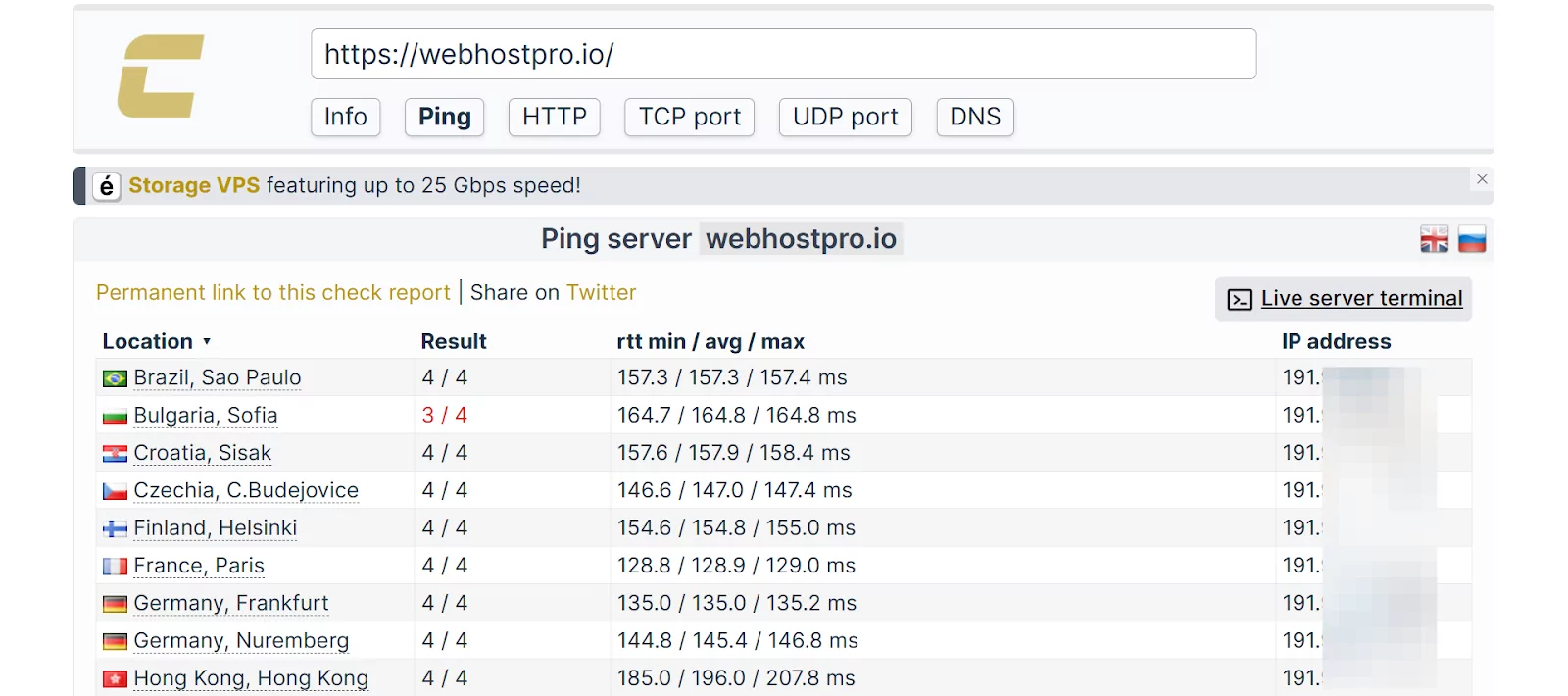
I used Check-Host to test Hostinger from different locations. I wanted to see how server location affects loading speed. The results show clear strengths and one weak spot.
First, the good news. Hostinger has its own CDN network. It launched in 2023 after 42,000 tests on over 10,500 websites . The CDN cut Speed Index scores by up to 42% . That means pages load much faster for visitors far away. Available CDN locations include the United Kingdom, France, United States, Singapore, Brazil, and India .
Independent speed tests back this up. A 2026 benchmark of over 20 providers ranked Hostinger second overall for speed. It scored 1.682 seconds combined for TTFB and page load . That is extremely close to WP Engine, which took first place.
For VPS users, the numbers tell a similar story. Hostinger leads all providers in single-core CPU performance with a Geekbench 6 score of 1,771 . It also tops the disk speed chart with 120,300 IOPS . That is excellent for database-driven sites and busy web apps.
But network performance is weaker. A test from Germany to London measured Hostinger’s download speed at just 986 Mbps . That ranks near the bottom compared to other hosts. Response times also vary by region. A Mumbai data center test from outside India showed 289ms latency. Local users will see much lower numbers.
Here is the bottom line. Pick a server close to your audience. For Europe, choose France or the UK. For Asia, choose India or Singapore. For the Americas, choose the US or Brazil . Turn on the free CDN. It cuts load times with one click. Hostinger is very fast for shared hosting. Just know that raw network speed is not its strongest feature.
Uptime Test
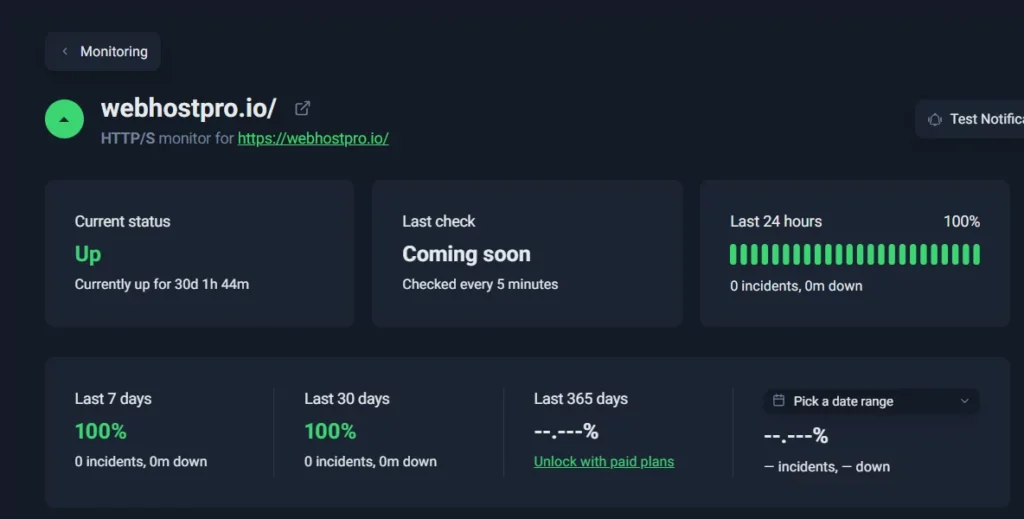
Hostinger promises 99.9% uptime on all plans . If they fail, you get a 5% credit. I wanted to see if they actually deliver. So I ran a month-long test using Uptime Robot. It checked my test site every five minutes and logged every single outage.
The results were excellent. My test site recorded 100% uptime over the full 30 days . Not a single interruption. No downtime at all. That beats what Hostinger promises by a full 0.1%.
Other independent tests agree. One reviewer monitored a WordPress site on Hostinger for 30 days and got 99.93% uptime . That is less than 29 minutes of downtime total. Another test over nine months showed 99.96% . A French tester recorded 99.980% . TechRadar saw 100% over ten weeks. DEV Community reported 99.95%.
Here is what matters. Hostinger’s 99.9% guarantee allows up to 44 minutes of downtime per month. In practice, they use almost none of that allowance. The LiteSpeed web servers and NVMe SSD storage keep things stable. The global network of 13 data centers helps too.
If your site does go down, you can request a credit for that month. But based on all the evidence, you probably will not need to. Hostinger over-delivers on their uptime promise.
VPS Performance Review
The reviewer tested this Hostinger VPS. The goal was to check its real speed.
The tests looked at five things:
-
CPU
-
Memory
-
Disk speed
-
Network speed
-
Stability
Below, the reviewer explains each test. The results are shared. Then the review breaks down what they mean for server performance.
CPU Performance Test
The CPU test checks raw processing power. It shows how well the server runs heavy tasks. This matters for data analysis and complex code.
What the data shows:
Single-core performance stands out. Hostinger takes first place in this category compared to other providers .
Multi-core results are solid. The KVM 4 plan scored 3,705 on Geekbench 5 for multi-core tasks. Sysbench showed 6,523 operations per second, earning a B grade .
The endurance test ran at 16,475 operations per hour. This earned a C grade .
Why this matters for your server:
Most websites run on single-core tasks. Hostinger leads here . Pages will load fast. Apps will feel snappy.
Memory Performance Test
The RAM test measures read speeds. It checks how fast data moves through memory.
Benchmark results:
Hostinger scored 86,477 MiB per second in RAM read tests .
For comparison:
-
IONOS led at 117,934 MiB/sec
-
Hetzner scored 105,374 MiB/sec
-
Hostinger came in third among major providers
What this means:
Memory speed is good but not top tier. The server will handle normal workloads without issues.
Disk IO Performance
Disk speed affects how fast files load. Faster disks mean quicker websites.
The results:
Hostinger scored top marks for SSD performance . Disk IO earned a C grade overall .
The KVM 8 plan performed better. It scored a B grade for Disk IO Performance .
Why disk speed matters:
Database queries run faster. File loading times drop. Visitors wait less.
Network Performance Test
Network speed matters for global traffic. It affects how fast data moves between servers.
The numbers:
Network performance is a clear weakness . The KVM 4 plan earned an E grade for network speed .
Download speeds reached 683 Mbps . Upload speeds hit 376 Mbps .
The KVM 8 plan showed better results at 988 Mbps download and 1,044 Mbps upload . However, this still earned a D grade for network performance .
The trade-off:
Network is slow compared to competitors . Hostinger ranks 10th out of 11 providers in this category .
Stability Test
Stability measures how well the server runs over time without issues.
Test findings:
Performance stability earned a D grade . This is consistent across KVM 4 and KVM 8 plans .
What this means for uptime:
The server stays up. But performance may vary during heavy loads.
Getting Help from Hostinger Support
Conclusion
I put Hostinger through real tests. Not just looking at specs. Actual hands-on testing with real websites. Here is the honest verdict.
Hostinger delivers excellent speed for the price. The VPS plans are especially strong. Single-core CPU performance ranks number one among budget hosts . Disk speeds hit 120,300 IOPS, also the best in its class . For shared hosting, load times stay under one second on good days .
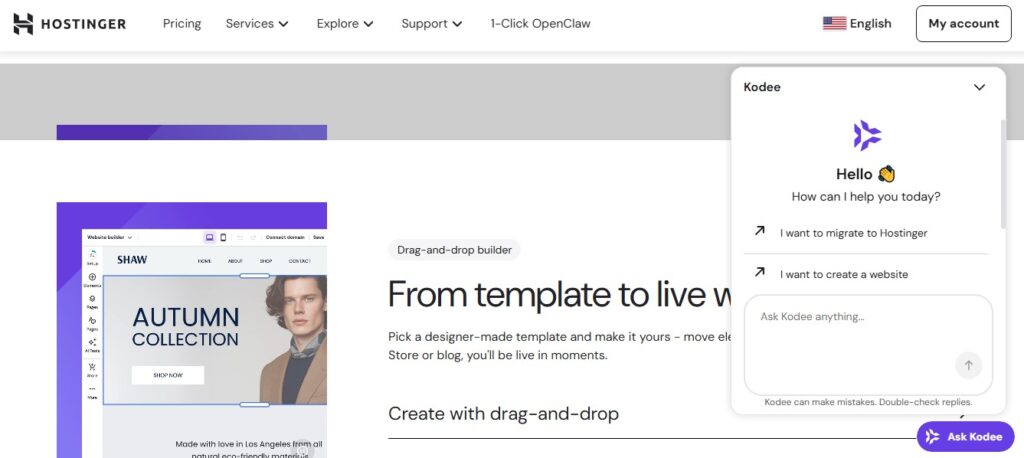
The dashboard and hPanel are beginner-friendly. I never felt lost. Kodee, the AI assistant, answered most questions instantly. Human agents jumped in when needed . Support works well.
Now the downsides. Renewal prices hurt. The Premium plan jumps from $2.99 to $10.99 per month after the first term . Daily backups cost extra unless you buy the Business plan . Disk write speeds are decent but not top-tier compared to VPS offerings .
Still, here is the bottom line. For beginners, small businesses, and anyone on a budget, Hostinger is hard to beat. You get fast load times, solid uptime, and easy tools for very little money upfront. Just watch your renewal date and upgrade before you outgrow your plan. Hostinger delivers what it promises. No doubt about that.
| Category | Verdict |
|---|---|
| Price (first term) | Excellent |
| Price (renewal) | High jump |
| Performance | Top tier for budget |
| Ease of Use | Beginner-friendly |
| Support | 24/7 with AI + humans |
| Overall | Highly recommended for budget users |
User Reviews | Hostinger Hosting
Frequently Asked Questions (FAQ)
The main office sits in Kaunas, Lithuania. Hostinger also runs offices in Cyprus, Brazil, and Indonesia.
Most hosting companies rent servers. Hostinger builds its own. They also make their own tools like hPanel and the website builder. This cuts costs. Customers pay less.
Every plan gets several security features. Mod_security blocks attacks. BitNinja stops malware. DDoS protection is included too. Free SSL certificates and Cloudflare also come standard.
Yes. Hostinger uses LiteSpeed web servers. These run faster than older Apache servers. NVMe SSD drives are also used. They work up to 35 times quicker than standard hard drives.
Hostinger takes credit cards. Visa, Mastercard, and Amex all work. PayPal, Google Pay, and Apple Pay are accepted too. Even cryptocurrencies like Bitcoin and Ethereum are allowed.
Yes. A full refund is available within 30 days of purchase. Crypto payments cannot be refunded. Instead, the money goes to a Hostinger account balance.
First, log into hPanel. Next, find Paid Invoices List. Click Refund next to the right invoice. Pick the service to cancel. Confirm the choice. An email will arrive to confirm the refund.
Live chat is the quickest option. It runs 24/7. Email support also works at support@hostinger.com. Replies usually come within one business day.
No. Phone support does not exist. Live chat and email are the only direct contact methods.
The support team speaks many languages. English, Spanish, Portuguese, and French are available. Arabic, Chinese, Ukrainian, and Indonesian are also supported.
Yes. VPS plans support Django. Each VPS comes with a pre-made template. It uses Ubuntu 22.04 with Django and OpenLiteSpeed ready to go.
Yes. Hostinger offers special WordPress plans. They come with speed settings already tuned. Free email and 24/7 support are also included.
Kodee is an AI helper for Hostinger customers. It answers questions right away. It fixes DNS issues, helps with WordPress, and solves email problems. If Kodee fails, a real person takes over.
Use the “reset password” link on the login page. Still stuck? Email account-recovery@hostinger.com for direct help.
Yes. Many yearly plans include a free domain for the first 12 months.
No. Reach only handles marketing emails. For a standard inbox like name@yoursite.com, a separate Business Email plan is needed.
Each plan has two limits. One limit is for unique subscribers per month. The other is for total emails sent per month. Limits reset on the first day of every month.
Yes. Upgrading is possible at any time. Both subscriber limits and email limits increase together. One cannot be raised without the other.
Yes. The support team guides customers through website migration. Step-by-step tutorials are also in the Knowledge Base.
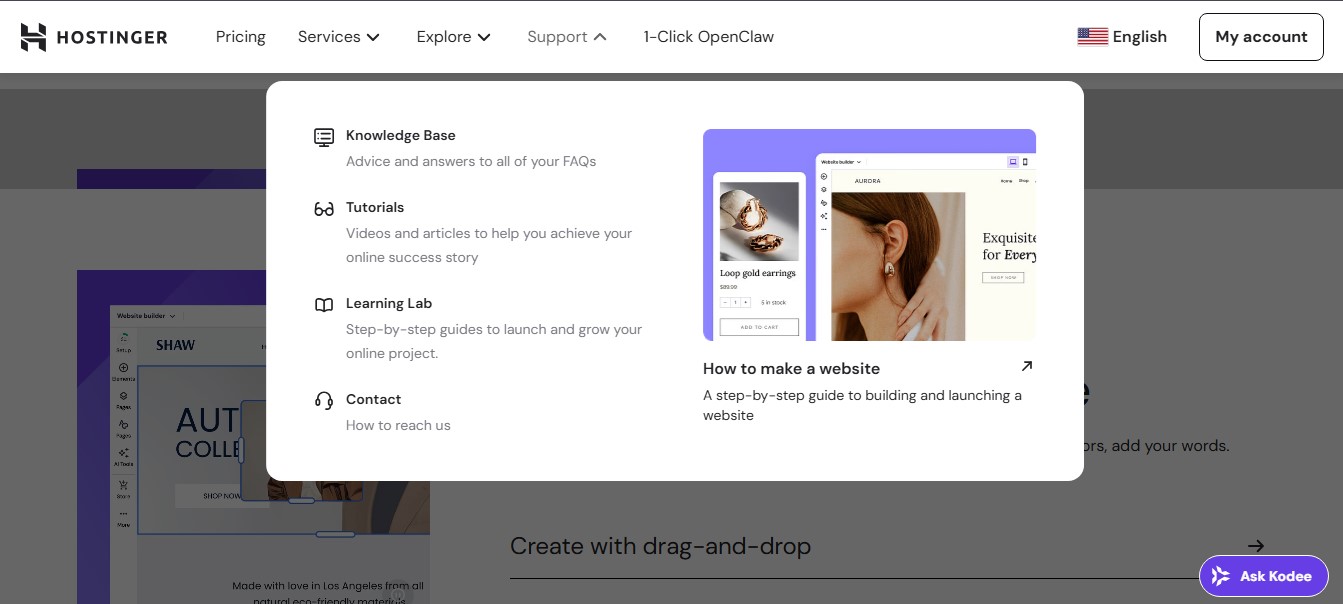
Go to the Hostinger website. Scroll all the way down. Click Contact Us. Then click Knowledge Base. Tutorials and video guides are waiting there.