
Data centers keep sprouting up. But powering them? That’s becoming a real headache. Texas just hit pause on new permits. Northern Virginia is scraping the bottom of the barrel for available capacity. And operators are now eyeing places like Alberta for their next big moves.
Here’s what’s shaking in the data center world.
1. Texas Slams the Brakes on Data Center Expansion
Texas spent years pitching itself as the go-to spot for data center development. That pitch just got quieter. Cost and power demands are now too big to ignore.
470+ data center projects want grid connections in Texas.
On Monday, September 21, Gov. Greg Abbott told state agencies to stop issuing new data center permits. Why? Officials need to audit how these facilities affect the state’s electrical grid.
“Simply put, Texans must come first,” Abbott said. “Data centers must pay their own way, protect our grid and water, and complete the ERCOT and TWDB audits. Until they do, TCEQ will issue no permits sought by data center projects.”
Reuters reports that more than 470 GW of projects are queuing up for grid connections. That’s way beyond the state’s peak demand. The audit will dig into electricity consumption, tax incentives, and water usage. No fixed end date is set—it hinges on the audits wrapping up.
2. Capacity Keeps Growing. Available Space Keeps Shrinking.
You’d think more buildings would mean more room. Wrong. CBRE’s latest North American Data Center Trends report (released September 8) says otherwise.
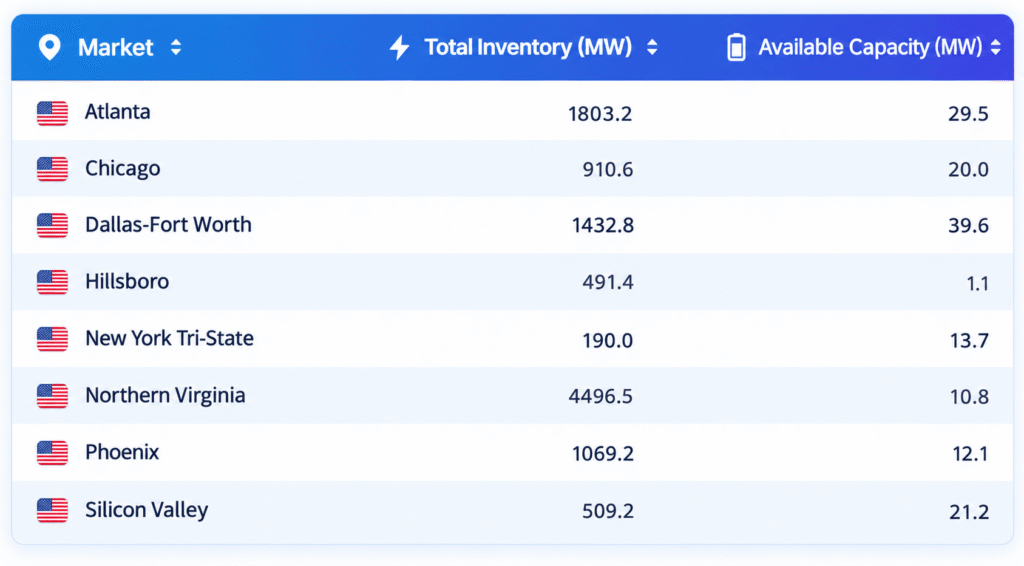
Northern Virginia added 1+ GW of capacity over the past year. Yet its vacancy rate fell to 0.2%. That leaves just 10.8 MW available. Companies are leasing space faster than operators can build it.
“Power is the deciding factor in Northern Virginia right now,” said Stu Dyer, Executive Vice President at CBRE’s Data Center Solutions Group. “Occupiers and capital sources that secure power early are the ones closing deals.”
The same story plays out across eight major North American markets—Northern Virginia, Dallas-Fort Worth, Silicon Valley, Chicago, Phoenix, New York Tri-State, Atlanta, and Hillsboro. More than 80% of capacity under construction is already leased. Less than 1,500 MW remains for companies wanting to reserve space.
Even AI data centers can’t dodge supply and demand.
3. New Regions and Existing Power Infrastructure Take Center Stage
Up in Alberta, Meta’s planned **C$13 billion** data center (~$9.4 billion USD) is putting the region’s land and energy resources in the spotlight. Reuters reported that Capital Power is in talks to supply electricity for other projects. Meanwhile, BCE plans to grow its Saskatchewan data center into a 1.2 GW hub.
Capital Power CEO Avik Dey thinks this could pull in even bigger names.
“Meta is the first to cross the line, but I think multiple hyperscalers have been evaluating Alberta for, I would say, the last 18 months,” Dey said. “I do feel strongly that we’ve got the potential to be a multi-gigawatt market.”
Down in Georgia, Google is helping Georgia Power boost electricity generation at its Vogtle and Hatch nuclear plants. The upgrades should add roughly 96 MW to Georgia’s grid. Georgia Power estimates the agreement could deliver $900 million in customer benefits over the plants’ operating lives. The deal still needs regulatory approval.
OK, So What?
They’re going to build anyway, right? Sure. But that doesn’t mean hosting providers can assume new capacity will be ready when they need it.
Power shortages. Permitting delays. Limited space. Any of these can push back expansion plans or jack up infrastructure costs. Just look at Texas—officials slammed the brakes on new data center permits until they finish auditing the grid impact. Alberta, on the other hand, is looking pretty good.
So if you’re a hosting provider planning to expand, check how much power and data center capacity a region actually has before you settle on your next location.

Leave a Comment