
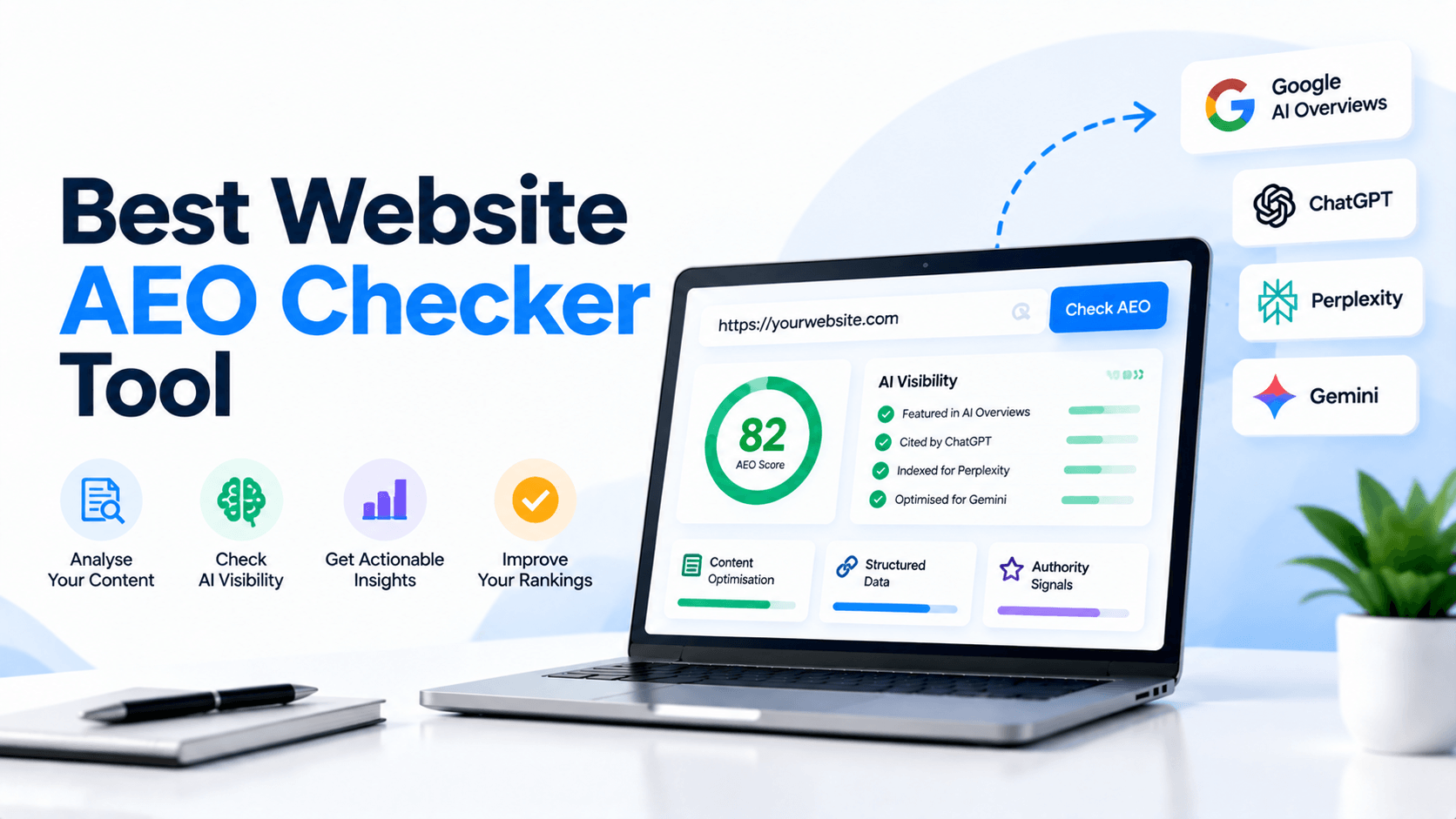
Answer Engine Optimization (AEO) helps you structure content for AI search tools. These include ChatGPT and Google AI Overviews. When you optimize correctly, these tools can understand your content. They can cite your brand. They can recommend your brand too.
Why does AEO matter? More searches are answered directly by AI now. SEO focuses on rankings and traffic. AEO focuses on AI visibility, mentions, and citations. Both work together. They improve your overall online presence.
This guide covers several important areas. We’ll explain AEO readiness first. Then we’ll discuss content structure. We’ll look at authority signals too. We’ll review monitoring tools. Finally, we’ll help you choose the Best Website AEO Checker Tool. The right tool boosts your visibility in AI search results.
What is a Website AEO Checker Tool?
A Website AEO Checker Tool examines your website’s AI search performance. It looks at answer engines too. It checks voice search readiness. It also evaluates featured snippet potential. The tool analyzes content quality. It reviews your site structure. It checks schema markup. It examines other AI-readiness signals.
How AEO Checkers Work
Most AEO analysis tools examine:
- Structured data implementation
- Question-based content
- Entity usage
- Content clarity
- AI crawler accessibility
- Technical website performance
- Featured snippet potential
The tool then generates recommendations for improvement.
Key Benefits
- Increased AI search visibility
- Better featured snippet opportunities
- Improved voice search rankings
- Enhanced content structure
- Better user experience
- Higher authority and trust signals
Why Your Website Needs an AEO Audit
Regular AEO audits keep your website visible. AI-powered search keeps changing. Audits help you stay ahead.
Higher Visibility in AI Answers
AI tools like ChatGPT and Perplexity prefer clear content. They like structured content too. They favor trustworthy information. An AEO audit checks your content. It verifies if AI systems can understand you. It checks if they can cite you. This improves your chances. You can appear in AI-generated answers more often.
Better Featured Snippet Opportunities
AEO audits review question-based content. They examine your headings. They check your lists and tables. They evaluate readability too. This helps search engines find direct answers. Your content can earn featured snippets.
Improved Voice Search Performance
Voice assistants like short answers. They prefer conversational replies. An AEO audit checks your content. It looks for natural language. It reviews question-based searches. It ensures you provide clear answers.
Enhanced User Experience
Optimizing for AI does not ignore human visitors. The same strategies work for both. Answer Engines and people want similar things.
AI tools prefer content that is:
- Clear and well-structured: Use descriptive headings. Keep paragraphs short. Add bullet points.
- Easily scannable: Put answers first. Let readers get key points quickly.
- Trustworthy: Add author bios. Include case studies. Share original data. This builds E-E-A-T. That stands for Experience, Expertise, Authority, and Trust.
Key Features of an Effective AEO Checker Tool
Best Website AEO Checker Tools analyzes several areas. It reviews your site structure.
Structured Data Analysis
Content Optimization Review
- Question-answer format: This checks for direct answers. It looks at common user questions. It identifies clear headings. It finds concise answers. The content must match search intent.
- Readability assessment: This measures content clarity. It evaluates language simplicity. It checks sentence length. It reviews explanation quality. Tools provide readability scores. They offer improvement suggestions too.
- Content relevance scoring: This compares your content to competitors. It identifies missing topics. It finds weak sections. It highlights areas for improvement. Your answers become more complete. They become more useful too.
AI Search Readiness Check
- AI crawler accessibility: This verifies AI crawler access. It checks page understanding. It identifies blocked resources. It finds JavaScript issues. It detects rendering problems.
- Content extraction: This evaluates information findability. It checks for buried content. It identifies long text blocks. Important information must be easy to find. AI systems must extract it easily.
- Entity recognition: This checks entity mentions. It looks at relevant topics. It reviews key concepts. It helps demonstrate expertise. It builds authority signals too.
Technical SEO & AEO Audit
Important AEO Metrics to Track
Tracking the right metrics helps you measure performance. It guides your improvements too. These metrics show your AEO progress.
- Answer relevance score: This measures answer quality. It checks how well you address user questions. Clear answers get better scores. Direct answers improve citation chances. AI systems prefer them.
- Featured snippet potential: This evaluates content structure. It checks for clear headings. It looks for concise answers. It reviews lists and FAQs. Good structure earns featured snippets.
- Voice search readiness: This checks conversational language. It looks for natural phrasing. People ask questions differently by voice. Your content must match their style.
- Schema implementation score: This measures structured data usage. It checks FAQPage markup. It reviews HowTo markup. It examines Article and Organization schema. Better scores mean better AI understanding.
- AI visibility score: This tracks brand mentions. It monitors AI-generated answers. It covers multiple platforms. These include ChatGPT. They include Gemini. They include Perplexity too. Higher scores mean more AI visibility.
How to Use a Website AEO Checker Tool
An AEO checker evaluates your AI visibility. It identifies optimization gaps. It improves your citation chances. Follow these steps to use one effectively.
Step 1: Enter Your Website URL
Most AEO tools need your page URL. You input the site you want to analyze.
- Browser extensions: Tools like GEO & AI Visibility Checker work instantly. SEO Analyzer Pro does too. They audit your current page with one click.
- Command-line tools: Options like geo-optimizer-skill are available. Consumableai-aeo works similarly. You provide a URL through the command line. Example:
geo audit --url https://yoursite.com. - Online platforms: WordPress tools like HiveEO exist. They provide a dashboard. You enter your URL there. The analysis begins immediately.
Step 2: Run the Analysis
After submitting your URL, the tool scans your website. Scan duration varies by tool complexity.
- Basic scans: Lightweight extensions work fast. They often complete in seconds.
- Comprehensive audits: These evaluate many AEO factors. They may take 30 to 90 seconds. Some take even longer.
- Browser-based analysis: Some tools process in your browser. This reduces processing time. Your data stays on your device too.
Step 3: Review AEO Recommendations
The tool generates a report after scanning. It highlights strengths and weaknesses for AI visibility.
- Check your score: Many tools give scores from 0 to 100. This summarizes your AI readiness. Some use ranges like 86–100 for Excellent. Others use 0–35 for Critical.
- Review category breakdowns: Look at each area individually. Check robots.txt accessibility. Review llms.txt availability. Examine schema markup. Assess meta tags. Evaluate content structure. Consider technical factors too.
- Find specific issues: Focus on actionable recommendations. Examples include “Missing llms.txt file.” Another is “Robots.txt is blocking GPTBot.” Some tools classify issues by priority. They use high, medium, or low impact labels. This helps you decide what to fix first.
Step 4: Implement Improvements
Your AEO report guides your fixes. You often add or edit files and code.
- Unblock AI crawlers: Check your robots.txt file. Allow trusted crawlers like GPTBot. Include ClaudeBot too. Add PerplexityBot. Ensure they access important pages.
- Create llms.txt: Add this file to your site. It provides AI systems with a clear overview. Include your key content there.
- Improve structured data: Add JSON-LD schema. Use Organization schema. Add Product markup. Include Article schema. Apply FAQ markup too. This helps AI systems understand your pages.
- Optimize content: Use clear headings throughout. Write short answers. Include lists and tables. Structure paragraphs well. This makes content easier to understand. AI engines can cite you more easily.
Step 5: Recheck Performance
After implementing improvements, run your AEO checker again. Confirm your changes worked.
- Compare your score: Use the same tool and URL. Check if your AEO score improved. Compare it with the previous audit.
- Review the results: Check which issues got fixed. Identify any new problems. The tool may find additional issues too.
- Compare before and after: Some advanced tools allow direct comparison. This makes improvement tracking easier. You see which changes boosted your AI visibility.
- Monitor regularly: Schedule periodic AEO audits. Track your performance over time. Maintain strong visibility across AI search platforms.
Common AEO Issues Found by Checker Tools
The Best Website AEO Checker Tool spot problems that hurt AI visibility. They look for weak structure, missing schema, poor accessibility, and low citability.
Missing schema markup: Schema helps AI systems read your page. It tells them what your content is about. Without FAQPage, HowTo, Article, or Organization schema, your content becomes harder to interpret. AI systems struggle to understand your page type.
Poor question-based content: AEO focuses on answering questions directly. People search with questions. AI systems look for clear answers. Checker tools flag content without Q&A sections, FAQs, or definition-first answers. Your content must address specific queries head-on.
Unclear page structure: AI systems rely on visual cues. They scan headings, bullet points, short paragraphs, and opening sentences. Poor structure makes information harder to extract. When structure fails, AI systems cannot cite your content properly.
Lack of entity optimization: AI systems use entities to connect information. Entities include people, businesses, organizations, and places. Unclear entities confuse AI systems. Your content becomes harder to understand accurately. Checker tools flag weak entity usage.
Weak E-E-A-T signals: Trust and authority matter to AI systems. Missing author details reduce credibility. Lack of credentials undermines expertise. Reliable citations and primary sources build trust. Updated content shows relevance. Without these signals, your chances of being referenced by AI systems drop significantly.
Best Practices to Improve AEO Scores
Best Website AEO Checker Tool needs a clear strategy. Here are key practices to help your content get cited by AI platforms like ChatGPT and Gemini.
Create FAQ Sections
The most important AEO practice is answering specific questions directly. Put answers early in your content. Lead with the answer, then add supporting context after. FAQ sections capture long-tail conversational queries. They provide clear question–answer pairs that AI systems can extract easily.
Use Clear Headings and Subheadings
AI models parse content like human readers do. They look for signals in headings and opening sentences. Use descriptive H2 and H3 tags. Match them to real user query language. Lead paragraphs with the key point. Skip the setup and get straight to the point.
Add Structured Data
Implement:
- FAQ Schema
- HowTo Schema
- Article Schema
- Organization Schema
- Product Schema
Optimize for Conversational Queries
Focus on natural language questions users are likely to ask.
Examples:
- What is Answer Engine Optimization?
- How does an AEO checker work?
- Why is schema markup important?
Build Topical Authority
AEO vs SEO: Which Matters More in 2026?
In 2026, both SEO and AEO are essential. Build a strong SEO foundation, then layer AEO strategies to maximize visibility.
Similarities
Both aim to improve visibility and user engagement.
Both require:
- High-quality content
- Technical optimization
- User-focused experiences
Differences
| Factor | SEO | AEO |
| Target | Rank in search engine results | Be cited in AI-generated answers |
| Output | List of links (click‑through) | Direct answer (often zero‑click) |
| Key Signals | Keywords, backlinks, Core Web Vitals | Clarity, factual accuracy, structure, entity consistency |
| Metric | Rankings, organic traffic | Citations, brand mentions in AI answers |
While SEO is designed to earn clicks, AEO is designed to earn citations in a generated response—often without the user ever visiting your site .
Why Both Should Work Together
Treating AEO as a replacement for SEO is a costly mistake . Instead, think of them as sequential layers :
- SEO builds visibility: It gets your pages crawled, indexed, and ranked. This remains the highest‑volume traffic channel .
- AEO captures attention: It structures your content for AI systems. These systems can extract your content as a direct answer. This gives you visibility in zero-click searches.
Who Should Use an AEO Checker Tool?
The Best Website AEO Checker Tool help anyone who wants better visibility. They work for AI-powered search and answer engines.
- SEO professionals: SEO experts can use AEO tools to find gaps. These gaps appear in schema and content structure. They also appear in entity optimization and authority signals. Traditional SEO audits may overlook these issues.
- Digital marketers: Marketers can check if their content answers audience questions directly. They can also see if the structure is clear enough. AI systems need clear structure to understand and cite content.
- Bloggers: Bloggers can use AEO tools to identify common questions. These tools help improve article structure. They also help create content that matches conversational searches and user intent.
- SaaS companies: SaaS businesses can optimize product pages and blogs. They can improve documentation and help articles too. This answers questions that potential customers ask AI assistants before buying.
- Local businesses: Local businesses can boost visibility for location-based searches. They need to present information clearly. This includes services, location, products, and expertise.
- E-commerce websites: E-commerce sites can optimize product pages and reviews. They can improve comparisons and buying guides. This answers questions that influence purchases. Questions cover product suitability, features, pricing, and alternatives.
Future of AEO and AI Search
Growth of AI-Powered Search Engines
AI platforms are changing how people find information. These include ChatGPT, Perplexity, Claude, and Grok. AI-generated answers are becoming more common. Businesses need content that these systems can understand. They also need content that AI trusts and can cite.
Impact of Conversational Search
Conversational search lets users ask natural-language questions. They can follow up without repeating the whole context. This makes search more interactive. It also increases the importance of creating content that answers specific questions directly.
Emerging Optimization Strategies
Future AEO strategies will increasingly focus on:
- Semantic and conversational search optimization
- Entity-based content structures
- AI-friendly formatting
- Advanced schema implementation
- Strong brand authority
- Clear, trustworthy, and citable information
Conclusion
Answer Engine Optimization (AEO) is becoming essential. AI-powered search is changing how people discover information. Businesses need content that works for both traditional search engines and answer engines.
The Best Website AEO Checker Tool can help identify issues. It checks content quality and schema. It also looks at technical performance and AI readiness. Regular audits make it easier to improve visibility. They also increase your chances of appearing in AI-generated answers.
Strong SEO fundamentals work well with effective AEO strategies. Together, they help businesses build a stronger online presence. This keeps you competitive as search evolves.
Start using an AEO checker tool today. Audit your website and improve its AI search visibility.

Leave a Comment