
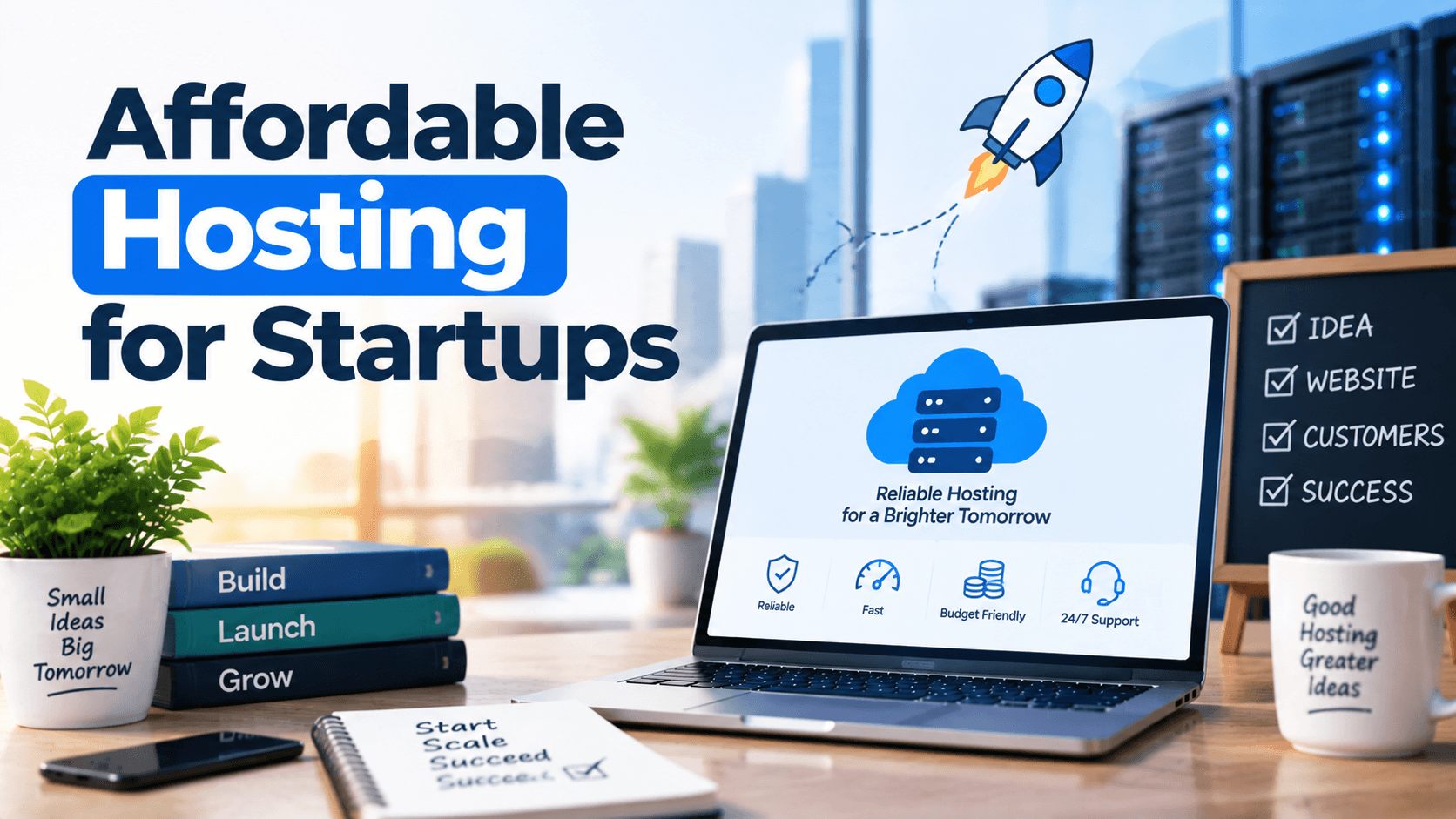
Choosing the right hosting is essential for startup success. Affordable Hosting for Startups should balance low cost with fast performance. Security and scalability also matter.
Features like NVMe storage boost performance. Free SSL keeps sites secure. AI tools help with management. Reliable backups protect your data. All of these improve performance without stretching your budget.
As traffic grows, consider VPS hosting. Cloud hosting is another option. Both offer greater flexibility. They also provide better scalability.
This guide covers affordable hosting types. It explains essential features and security. Scalable solutions are also discussed. All of this helps your startup build a reliable online presence.
What Startups Should Look for in Affordable Hosting
Cheap hosting is not all the same. Startups need a good balance of cost, performance, and room to grow. Here are the key things you should check.
- Pricing vs value – The lowest price can hide extra costs. You might get slow speed, weak support, or surprise fees. Look for clear pricing. It should include SSL, backups, and a CDN.
- Uptime and reliability – Your site needs to stay online. A 99.9% uptime guarantee protects your credibility. Downtime hurts sales and trust.
- Speed and performance – Fast sites keep visitors happy. They also rank higher in search results. Pick hosts with SSD storage, caching tools, and a CDN.
- Scalability for growth – Your startup will not stay small. Choose hosting that lets you upgrade CPU, RAM, and storage. This should be easy. You should not have to move to a new server later.
- Customer support quality – You need 24/7 help. Live chat or phone support is best. Test their response time before you commit.
- Security features – Free SSL is a must. Daily backups protect your data. Malware scanning and DDoS defense guard your reputation. These are not optional.
Pick a host that meets all these needs. Do not choose only by price. Your startup needs a strong foundation. One that supports your future.
Types of Hosting Suitable for Startups
Picking the right hosting for your startup can feel hard. But it does not have to be. Match your hosting type to your traffic, budget, and tech skills. Here are the best options for startups in 2026.
Shared Hosting – Best for Beginners
- Most affordable option ($3–15/month)
- No technical skills required
- Hosting provider handles server management
- Performance can be affected by neighboring sites
- Limited resources for traffic spikes
Best for: Personal blogs, portfolio sites, small business websites, and startups just getting started.
VPS Hosting – For Growing Startups
- Dedicated resources (CPU, RAM, storage)
- Consistent performance — no “noisy neighbors”
- Root access for custom configurations
- Requires more technical knowledge
- Higher cost ($20–100/month)
Best for: Startups with growing traffic, eCommerce stores, and businesses needing custom software.
Cloud Hosting – Scalable & Flexible
- Resources scale automatically during traffic spikes
- Pay only for what you use (pay-as-you-go)
- High reliability (redundant servers)
- Pricing can be unpredictable
- More complex to configure
Best for: Startups with variable traffic, SaaS products, and seasonal businesses.
Managed Hosting – Hands-Free Option
- Provider handles security, updates, and backups
- Optimized for specific platforms (WordPress, WooCommerce)
- Expert support available 24/7
- Higher cost ($30–200+/month)
- Less control over server configuration
Best for: Non-technical founders, busy entrepreneurs, and startups wanting to focus on business, not servers.
Best Affordable Hosting Providers for Startups
Best Affordable Hosting for Startups, Here’s a quick breakdown of the best options for early-stage founders in 2026:
Shared Hosting Options (Best for Getting Started)
- Hostinger – Plans start as low as £2 per month. This makes it one of the most affordable entry points for startups. Great for beginners and smaller websites.
- Bluehost – This host is recommended by WordPress. It has solid features and a beginner-friendly interface. Ideal for startups launching on WordPress.
- Namecheap – A simple, budget-friendly option starting around $1.98/mo. Perfect for startups wanting basic hosting without extra bells and whistles.
Scalable Hosting Options (Best for Growth & Development)
- DigitalOcean – A developer-friendly cloud platform. It offers simple virtual servers (Droplets) starting at $4/mo. Great for apps, APIs, and custom projects that may need to scale.
- Vultr – Affordable, high-performance cloud infrastructure. It has multiple global locations. VPS plans start around $2.50/mo.
- AWS (Amazon Web Services) – The industry leader with massive scalability. It offers global reach and flexible pay-as-you-go pricing. AWS Lightsail gives simpler entry points for small projects starting at $3.50/mo.
Pros and Cons of Cheap Hosting
Cheap hosting is tempting. This is especially true when you are just starting out. Every dollar counts. But is it the right choice for your startup? Let us break it down.
Advantages of Cheap Hosting
- Low Cost: The biggest draw is the price. Plans start as low as $2–$5 per month. This makes it accessible for bootstrapped startups and side projects.
- Easy Setup: Most cheap hosts offer one-click WordPress installation. They also provide drag-and-drop builders. Their dashboards are user-friendly. You do not need technical expertise.
- Beginner-Friendly: They offer 24/7 support. It is sometimes basic, but it is there. They also have extensive knowledge bases. Cheap hosting is designed for people who are new to website management.
Disadvantages of Cheap Hosting
- Limited Resources: You get what you pay for. Shared CPU, RAM, and bandwidth are common. This means your site can slow down significantly during traffic spikes.
- Slower Performance: Many other sites share your server. Dozens or even hundreds. This can hurt page load times. Slow speeds hurt user experience. They also hurt your SEO.
- Shared Environment Risks: Your site shares a server with neighbors. If one neighbor gets hacked, your site can be affected too. If a neighbor gets a traffic surge, it can affect you. Security isolation is minimal.
How to Choose the Right Hosting for Your Startup
Choosing the right hosting can feel overwhelming. But it does not have to be. Break it down into a few key factors. This makes the decision much easier. Here is a simple guide to help you decide.
Based on Website Type
- Blog or Portfolio → Choose shared hosting or managed WordPress. It is easy and affordable.
- SaaS or Web App → Choose cloud or VPS hosting. It is scalable and gives you more control.
- eCommerce Store → Choose managed WooCommerce, Shopify hosting, or cloud. It is secure and offers fast checkout.
Expected Traffic
- Low traffic (under 5,000 visits/month) → Shared hosting is usually enough.
- Medium traffic (5,000–50,000 visits/month) → VPS or cloud hosting gives you consistent performance.
- High traffic (50,000+ visits/month) → Cloud or dedicated hosting with auto-scaling works best.
Technical Skills of Your Team
- No server experience → Choose managed hosting. They handle updates, security, and backups for you.
- Some technical knowledge → Choose VPS with a control panel. Options like cPanel or Plesk are good.
- DevOps or developer team → Choose unmanaged cloud or dedicated servers. You get full control.
Budget Planning for 1–3 Years
- Year 1: Start small. Use shared hosting or entry-level VPS. Cost: $5–20/month.
- Year 2: Scale up. Move to cloud or managed hosting as traffic grows. Cost: $20–100/month.
- Year 3: Go big. Consider dedicated or enterprise cloud for high volume. Cost: $100+/month.
Common Mistakes Startups Make When Choosing Hosting
Choosing the wrong hosting can hurt your Affordable Hosting for Startups. It can cause problems before you even get traction. Here are the most common pitfalls to avoid.
Mistake #1: Choosing Only Based on Price
The cheapest plan is tempting. But it often comes with a hidden cost. Ultra-low pricing usually means overcrowded servers. You get slow load times. There is also no room to grow. A $3 plan may not handle your traffic spike. It will cost you more in lost sales.
Mistake #2: Ignoring Scalability
Your startup will grow. It will not stay small forever. Many founders choose hosting that works today. But it fails tomorrow. Real scalability is designed, not purchased. If you cannot upgrade resources easily, you will face problems. You may need painful migrations. Your site may crash during growth.
Mistake #3: Not Checking Renewal Prices
That $3 monthly price looks good. But it often jumps to $10–$15 after the first term. Many startups assume renewal is a good deal. Then they discover they are overcharged. Always check renewal rates before you commit.
Mistake #4: Overlooking Support Quality
Your site may crash at 2 AM. Slow support means lost revenue. Many budget hosts offer ticket-only support. Response times can be 24+ hours. For a startup, that is not acceptable. Test support before you buy.
Tips to Save Money on Hosting
You can save money on hosting. You do not have to give up quality. Here are some practical ways to do it.
Use Long-Term Plans (1–3 Years)
Most hosting providers offer big discounts. You get them when you commit to longer billing cycles. A 1- to 3-year plan can cut your monthly costs by 40–60%. Compare that to month-to-month pricing. Just make sure you trust your host before you lock in.
Take Advantage of Startup Credits
Major cloud providers offer credits for startups. AWS, Google Cloud, and DigitalOcean have programs like AWS Activate and DigitalOcean Hatch. These credits can cover your hosting costs for months or even years. This gives you breathing room to scale.
Avoid Unnecessary Add-Ons
Hosting companies love to upsell. They push premium SSL. But free Let’s Encrypt works fine. They push dedicated IPs. You may not need them. They push advanced backups. A simple plugin will do. They push managed security. Good plugins often make it redundant. Only pay for what you truly need.
Use a CDN for Performance Optimization
A Content Delivery Network (CDN) speeds up your site. It works globally. It also reduces server load. Cloudflare is a good example. Often, you can use a lower-tier hosting plan. You do not lose performance. Many CDNs offer free tiers. They are perfect for startups.
Final Recommendations
Choosing the right hosting for your startup can feel overwhelming. But it all comes down to your priorities. Here is our final verdict on the best options available.
Best Option for Beginners
Hostinger is our top pick for startups just getting started. It offers:
- Budget‑friendly plans starting as low as $2.69/month (promo pricing)
- 99.99% uptime and fast NVMe SSD storage
- An intuitive, user‑friendly dashboard with AI tools that simplify site creation and management
- 24/7 live chat support for when you need help
If you want maximum value with minimal learning curve, Hostinger is the clear winner.
Best Option for Developers
Cloudways is the go‑to choice for tech‑savvy founders who value flexibility and control. It offers:
- Choice of 5 cloud providers, including AWS, Google Cloud, and DigitalOcean
- Pay‑as‑you‑go pricing with no long‑term contracts
- Full root access to servers for custom configurations and deployments
- Built‑in staging environments and Git integration for seamless DevOps workflows
Cloudways gives developers the power of the cloud. It does so without the complexity of managing it from scratch.
Best Scalable Option for Fast‑Growing Startups
Liquid Web is built for startups that anticipate rapid scaling. It delivers:
- 100% uptime guarantee with aggressive SLA credits
- Premium performance optimization, including up to 10x faster caching
- Fully managed hosting with proactive monitoring and expert support
- Seamless scalability from VPS to dedicated servers as your traffic grows
If your startup is in e‑commerce, SaaS, or any high‑traffic space, Liquid Web ensures your hosting grows with you.
Conclusion
Choosing the right hosting is essential for your startup. It affects performance, security, and growth. Affordable Hosting for Startups should offer reliable uptime and fast speeds. It should include SSL, backups, and responsive support. It also needs room to scale.
Shared hosting works well for MVPs and small websites. VPS or cloud hosting is better as traffic grows. Do not choose based only on price. Poor performance can hurt your business. Hidden costs can hurt it too.
Ready to choose the right hosting for your startup? Compare affordable plans. Start small. Upgrade as your business grows.

Leave a Comment